
Silicate binder quality control connects the chemistry of sodium and potassium silicate solutions with their behaviour during mixing, electrode coating and flux granulation. A useful inspection plan checks material identity, composition, concentration and viscosity under defined conditions, then links those results to manufacturing performance.
Explore the Quality Control Hub →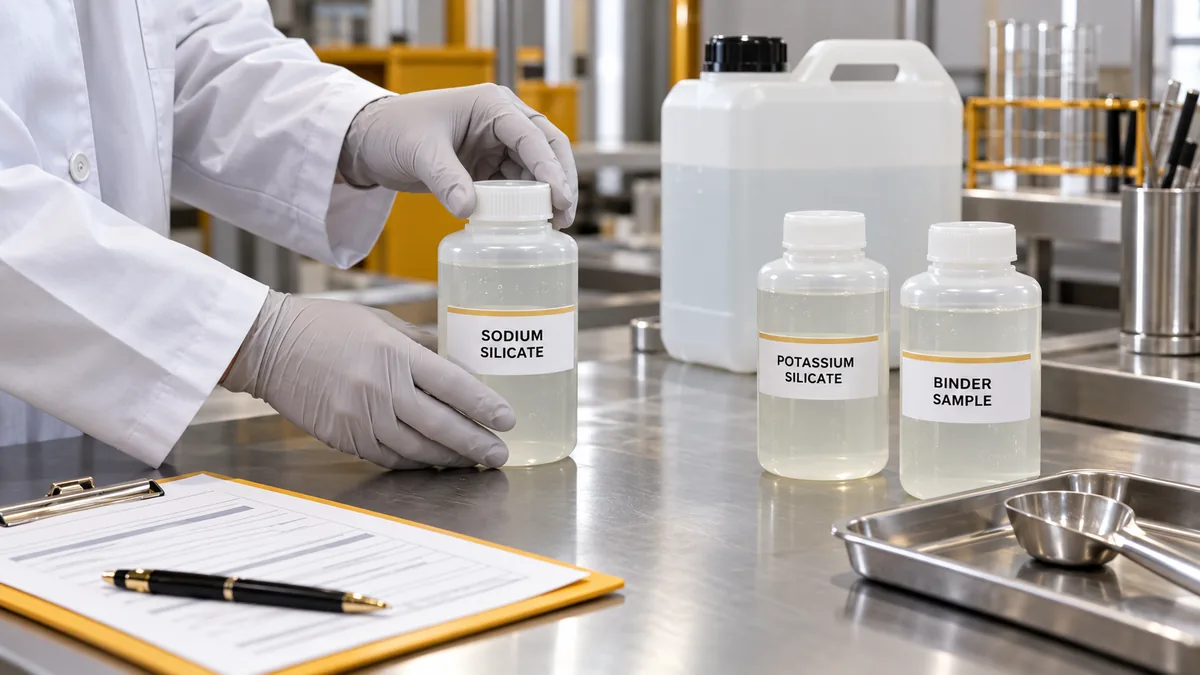
Why Silicate Binder Quality Matters
Soluble silicates, often called water glass, are used as binders in covered-electrode coatings and in relevant agglomerated welding-flux processes. In electrode manufacture, the binder helps the powder blend form a workable coating mixture and contributes to the strength of the dried coating. In agglomerated flux production, binder performance must be assessed together with granulation and the subsequent thermal process.
This article focuses on liquid sodium silicate, potassium silicate and specified mixtures of the two. It also addresses solutions prepared from soluble solid silicates. The controls should not be transferred automatically to fused flux production, solid-wire manufacture or every flux-cored wire formulation.
A binder should not be selected by viscosity alone. The alkali type, silica-to-alkali ratio and concentration are part of its identity. Two liquids with similar flow behaviour may deliver different quantities of silica, sodium oxide or potassium oxide to the product. Supplier product information likewise distinguishes silicate grades by composition and properties; suitability remains application-specific.
Define the Approved Grade Before Testing It
The purchasing specification should identify the manufacturer, grade and intended use, together with measurable acceptance criteria. A description such as “potassium silicate adhesive” is too broad to establish interchangeability. Separate the specification for the delivered binder from the specification for a diluted or blended production solution.
| Characteristic | What to Specify | Reason for Control |
|---|---|---|
| Identity and alkali type | Sodium, potassium or mixed silicate; approved source and grade | Prevents substitution by a liquid with different chemical contributions |
| Silica and alkali contents | SiO2, Na2O and/or K2O, normally as mass percentages on a stated basis | Defines chemical delivery and permits calculation of the specified ratio |
| Silicate ratio | Numerator, denominator, and whether the ratio is by mass or by moles | Avoids comparing unlike supplier declarations |
| Solids or concentration | Analytical definition, method and reporting basis | Controls binder solids and water introduced into the mix |
| Density | Units, test temperature and measurement method | Supports consistency checks and mass–volume calculations |
| Viscosity | Units, temperature, instrument geometry and operating conditions | Makes results reproducible and comparable |
| Appearance and insoluble matter | Acceptable appearance and a defined inspection or residue method where needed | Detects contamination, deposits and changes requiring investigation |
| Storage and traceability | Supplier storage instructions, usable life or retest date, lot identification and change notification | Maintains control between receipt and consumption |
Set numerical limits from qualified formulation and process evidence. There is no single viscosity, density, silicate ratio or solids range that is correct for all welding-electrode and flux products.
Take a Representative Sample and Preserve Its Condition
Identify the supplier lot, delivery container or tanker compartment, receiving tank and sampling point. Review container condition and the certificate of analysis before transfer. Plan the receiving arrangement so that material awaiting approval cannot be mixed unintentionally with released stock.
- Define the sampling plan: choose containers, locations or transfer increments appropriate to the delivery. Do not assume a surface sample represents a bulk tank.
- Check uniformity: where required, use a documented, supplier-compatible mixing or circulation procedure. Record visible sediment, skin or gel before homogenization.
- Use suitable equipment: select clean, compatible sampling tools and containers. Residual wash water must not dilute the sample.
- Close and identify the sample: record lot, location, time, temperature where relevant and sampler. Minimize exposure and evaporation.
- Preserve evidence: retain a sealed reference portion when required. Do not filter, dilute or otherwise alter the acceptance sample unless the approved analytical method requires it.
If samples from different locations differ, investigate the variation before making a composite that could hide it. Where receipt requires unloading before results are available, maintain an identifiable hold status and controlled segregation until the authorized release decision.
See the guides to representative sampling and sample preparation and incoming raw material quality control for the wider inspection framework.
Check Composition, Ratio and Solids as Separate Questions
State Whether the Silicate Ratio Is by Mass or by Moles
For a sodium silicate, the mass ratio is the mass of SiO2 divided by the mass of Na2O. The molar ratio divides each oxide mass by its molar mass before calculating the ratio. These quantities are related, but they are not identical.
For mixed sodium–potassium binders, specify both oxide contents and the agreed ratio convention. If the specification defines a molar silica-to-total-alkali ratio, use (SiO2/60.08) divided by [(Na2O/61.98) + (K2O/94.20)], with oxide mass percentages as inputs. Do not apply the sodium-only conversion factor to a mixed binder.
Use Methods Suitable for the Actual Binder
Wet-chemical methods, including titrimetric and gravimetric procedures, can form part of silicate analysis. Instrumental methods may also be suitable after validating sample preparation, calibration and the required analytes. A total-alkalinity titration alone does not independently establish the sodium-to-potassium split of a mixed binder.
Distinguish the sum of reported oxide contents from a drying-residue result. They should not be treated as interchangeable without method validation, especially when a binder contains additional constituents. For a gravimetric residue method, document sample mass, preparation, drying conditions, endpoint, cooling and weighing. This article does not prescribe a universal drying temperature or laboratory recipe.
Use Density as a Check, Not a Complete Chemical Analysis
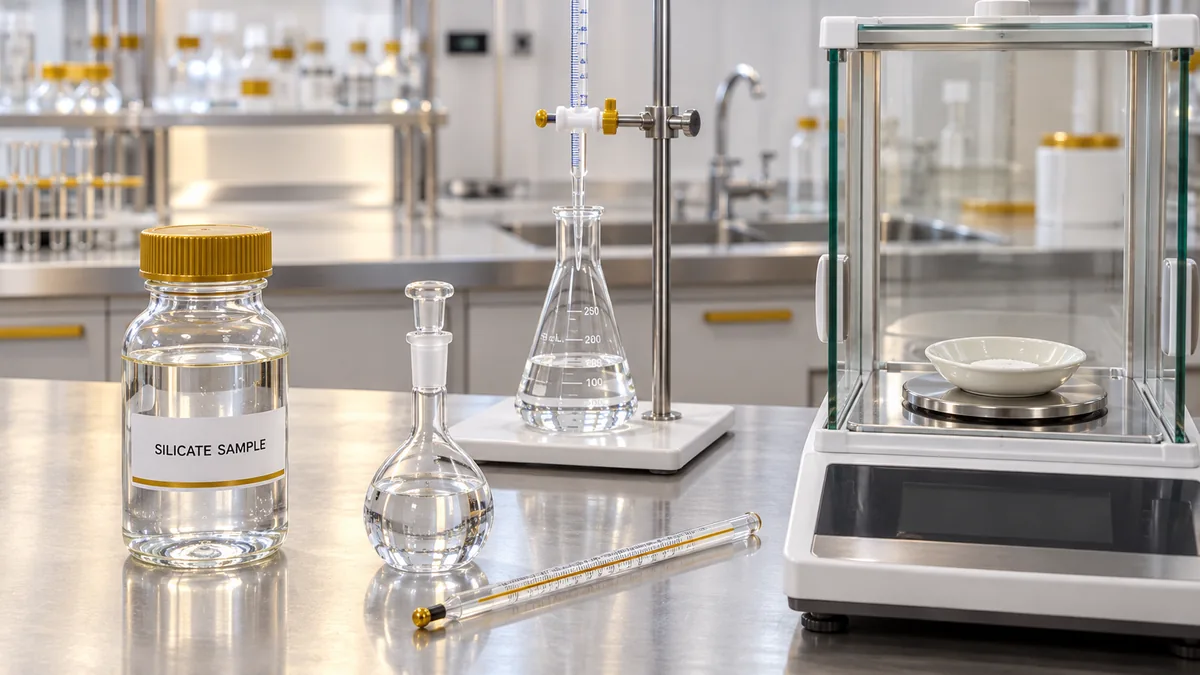
Measure density at the specified temperature using a suitable calibrated method, such as a density bottle, hydrometer or digital density meter. Avoid bubbles and follow the instrument's filling and reading procedure. Report density in defined units; relative density and degrees Baumé require their own reference conventions.
A density-to-concentration relationship is useful only within its validated composition and temperature range. Matching density does not prove matching silicate ratio or alkali type. For method selection, see chemical analysis of raw materials.
Measure Viscosity Under Reproducible Conditions
A viscosity result without its test conditions is incomplete. A cooler sample can appear more viscous than a warmer sample of the same material. Differences in instrument geometry, immersion, sample preparation or reading time can also compromise comparisons.
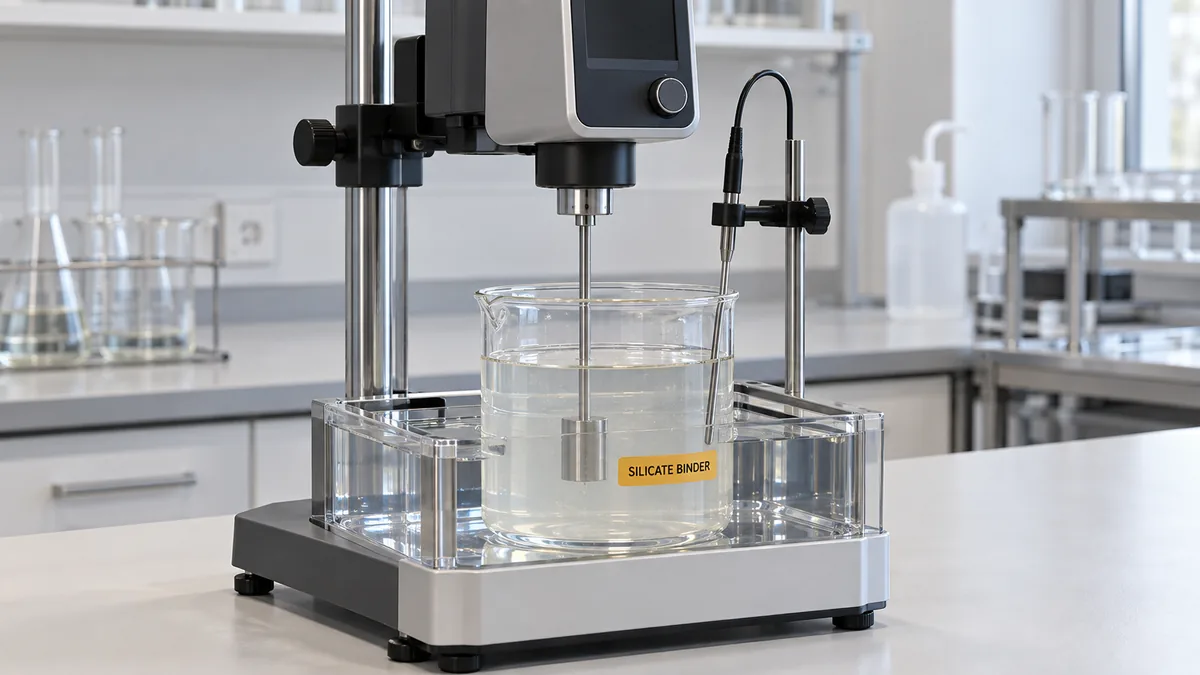
Use the instrument manufacturer's method to define the complete test setup. Record sample temperature, instrument identification, spindle or rotor, speed where applicable, container geometry, sample volume or immersion depth and the reading endpoint. Confirm that the result falls within the instrument's valid measurement range.
- Allow the sample and measuring system to reach the specified thermal condition.
- Check for bubbles, surface skin and contamination; document their presence.
- Use the specified clean container and immersion arrangement.
- Follow the prescribed reading time or stability criterion and repeatability rule.
- Report the units explicitly: 1 mPa·s = 1 cP; 1 Pa·s = 1,000 cP; 1 dPa·s = 100 cP.
Do not copy the rotor, speed, accuracy or verification interval of one viscometer into the procedure for another model. A fixed-speed comparative instrument and a programmable rheometer require different operating instructions.
Verify the Measurement System
Check performance using a suitable certified viscosity standard under the manufacturer's specified conditions. Assess the result against the combined applicable instrument and reference-fluid tolerances. Verify temperature measurement as well. AMETEK Brookfield's guidance illustrates why the standard fluid, geometry and thermal equilibrium all matter; its model-specific details are not universal settings for other instruments.
A successful reference-fluid check does not by itself validate sampling or the binder test method. If a check fails, investigate the equipment and assess which earlier results may be affected before relying on them for release.
Control Storage, Transfer and Solution Preparation
Follow the grade-specific supplier instructions for storage temperature, usable life, compatible equipment and handling. Protect containers from contamination and unintended water loss. Record unusual temperature exposure, changes in appearance or prolonged storage and determine whether retesting is required.
Keep transfer routes and tank contents identifiable. Topping up a tank creates a mixed inventory: record the contributing lots and affected production batches. A retained sample from the latest delivery alone does not describe the entire mixed tank.
If soluble solid silicate is dissolved on site, control water quality, ingredient masses, dissolution conditions and the identity of the prepared solution. Check the finished solution against its own specification before use. Undissolved material, unexpected residue or incomplete dissolution requires investigation.
Silicate handling arrangements should follow the supplier's safety data sheet, including appropriate eye and skin protection. Do not improvise chemical corrections to a tank to restore an apparent property; adjustments require a defined, authorized procedure.
Connect Liquid Binder Results to the Production Formula
Control both the amount of solution added and the solids and water it contributes. Record the binder lot, blend proportions, dilution water, addition sequence and relevant mixing conditions. Where dosing is volumetric, use a valid density at the dosing condition to relate volume to mass.
Pure-water dilution, assuming no reaction or loss, does not change the silica-to-alkali ratio, but it changes concentration and liquid dosage requirements. Sodium–potassium blending changes composition as well; calculate component contributions from their masses and analyses rather than averaging ratios.
Observe the Relevant Manufacturing Response
For covered electrodes, monitor paste consistency, working time, extrusion response, coating condition and strength after the specified drying and baking cycle. For agglomerated flux, monitor granulation behaviour, granule integrity, fines and screening yield. Binder condition is one possible influence among powder characteristics, equipment and process settings.
Do not respond to every stiff mix by adding water. Check powder moisture, particle size distribution, binder temperature, dosing and mixing history. Likewise, liquid-binder water content is not a direct measure of finished-consumable moisture or diffusible hydrogen.
Make Acceptance and Corrective Actions Traceable
| Observation | Checks to Make | Controlled Response |
|---|---|---|
| Viscosity differs from the certificate | Temperature, units, method, sample condition and instrument verification | Repeat under comparable conditions; investigate persistent disagreement |
| Density is acceptable but viscosity is unusual | Composition, ratio, thermal history, contamination and test setup | Do not release on density alone |
| Unexpected skin, gel or sediment | Receipt condition, storage history, mixing and representative samples | Hold for evaluation; do not conceal the condition by unapproved filtering or dilution |
| Laboratory results pass but processing deteriorates | Dosage, powder lots, water balance, mixing and equipment | Trace affected batches and compare against the qualified reference process |
| Supplier, grade or alkali blend changes | Specification differences and consequences for manufacturing and product performance | Perform a documented change review and appropriate pilot qualification |
The laboratory reports conformity to the defined tests; the authorized technical and quality function decides the permitted use. Record acceptance, hold or rejection and any restrictions. Retesting should resolve a documented question, not continue until a passing value appears.
For a new binder or a meaningful change, use the raw material qualification and pilot production process. Compare the candidate with the approved binder under controlled conditions and select product tests according to the change and product requirements. An isolated trial authorization is not routine-production approval.
Minimum Lot Record
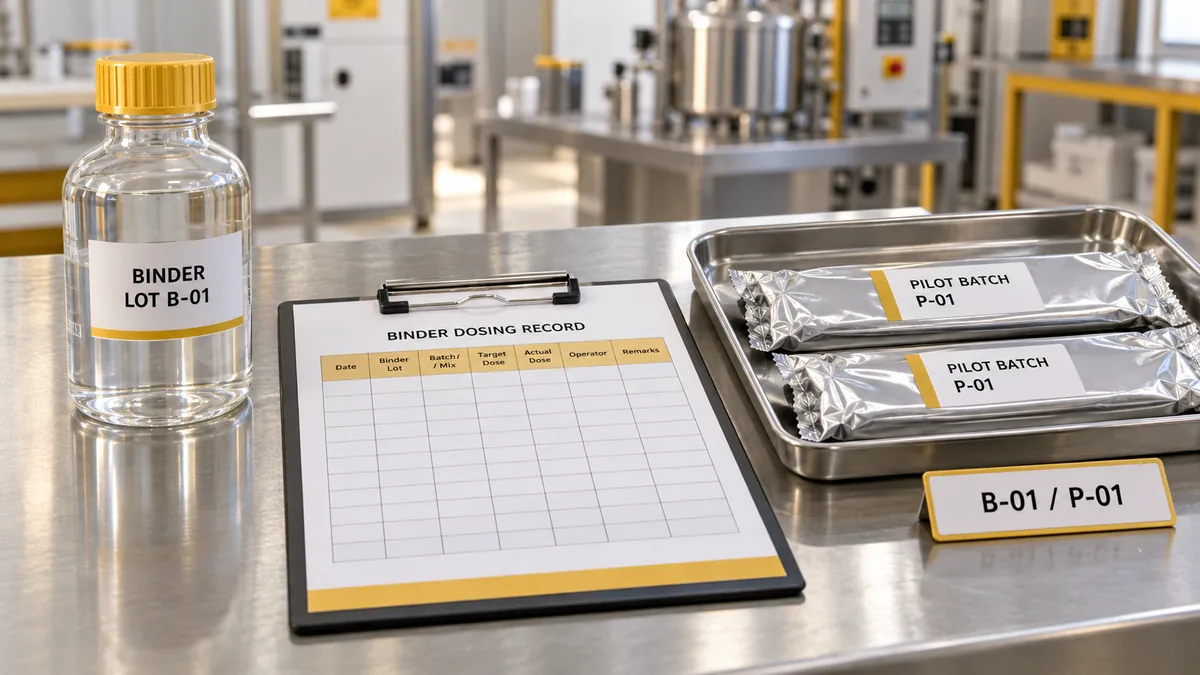
Retain supplier and internal lot identities, receiving location, sample identity, specification revision, analytical methods, measured conditions, results, instrument checks, reviewer and release status. Link subsequent blending or dilution records to the production batches that consumed the binder.
Frequently Asked Questions
Can viscosity alone confirm silicate binder quality?
No. Use it alongside identity, composition, concentration and relevant physical checks. Similar viscosity does not establish chemical equivalence or suitability for a formulation.
Can sodium and potassium silicates be substituted directly?
Not solely because their density or viscosity matches. Review the chemical contribution and qualify the change for the intended formulation and process.
Does adding water correct an out-of-specification binder?
It may change concentration and flow behaviour, but it does not correct the wrong alkali type or silica-to-alkali ratio. Any permitted adjustment needs authorization, a mass balance and verification.
Should every binder be measured at the same temperature?
Use the temperature defined by the approved specification and method. Supplier and factory results must be compared on a consistent basis; no temperature stated here is a universal acceptance condition.
Should an approved binder be rechecked after storage?
Recheck when the inspection plan, retest date, storage event or observed production problem requires it. Initial acceptance does not establish unchanged condition indefinitely.
Technical References and Further Reading
The following manufacturer resources provide background on soluble silicates and viscosity measurement. They do not set universal acceptance limits for welding-consumable binders; apply the qualified material specification and the instructions for the actual equipment.
- PQ: silicate products and composition — sodium and specialty silicates, their functions and grade-dependent properties.
- PQ: specialty silicates for industrial welding applications — background on tailored binder applications.
- OxyChem: sodium silicate technical and product information — grade-specific documents and supplier guidance.
- AMETEK Brookfield: viscosity and rheology FAQs — measurement conditions and temperature effects.
- AMETEK Brookfield: checking instrument calibration — reference-fluid checks and interpretation within the stated equipment scope.