
Raw material quality control is the first technical barrier between a purchased material and the welding consumable production line. A controlled approval system should identify the material, verify it against an approved specification, obtain a representative sample, perform the required tests and document a clear decision before routine use.
Back to Welding Consumables Quality Control HubWhy Raw Material Quality Control Matters
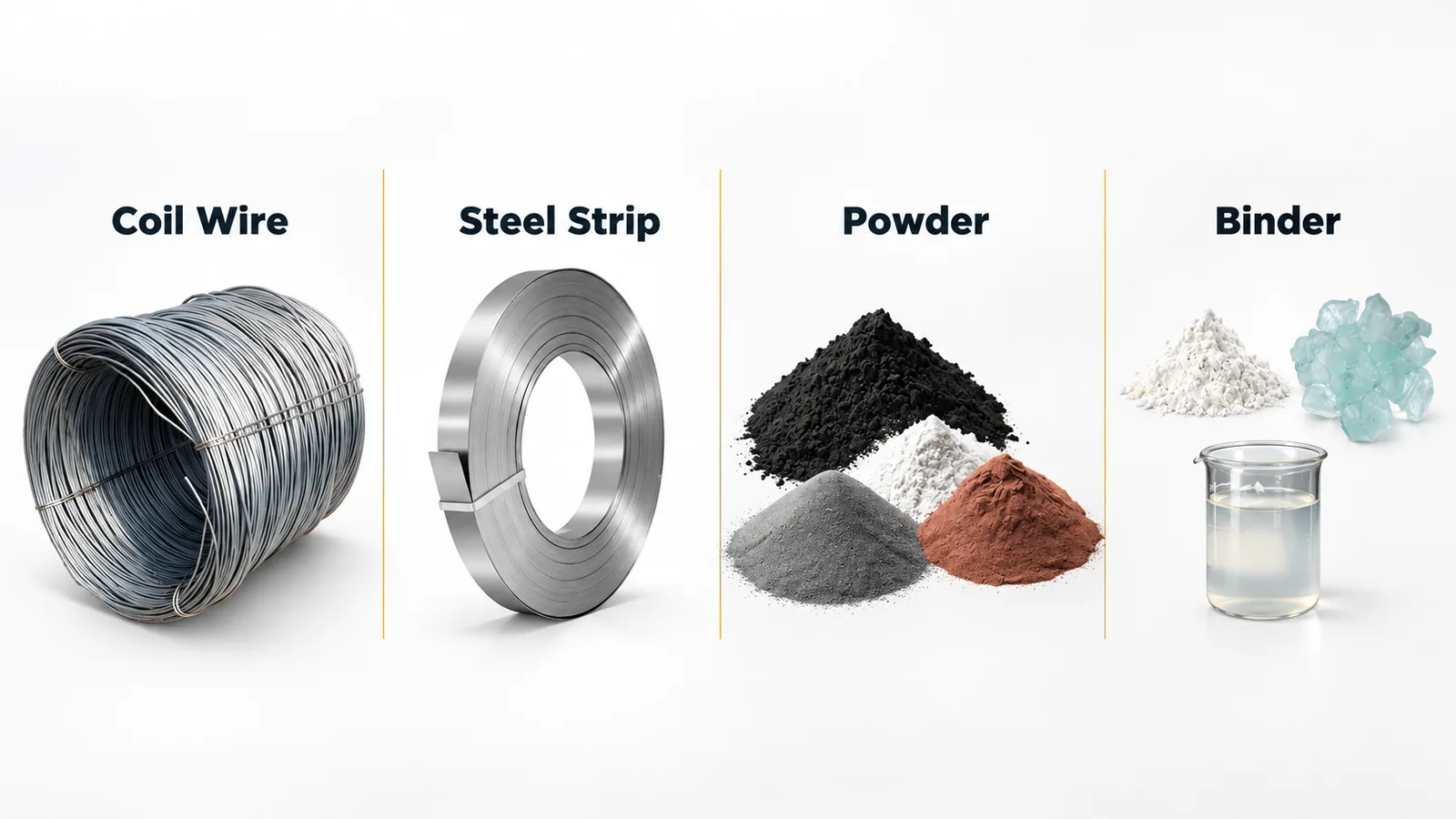
Welding consumables are produced from several material families with very different characteristics. Covered electrodes and welding fluxes may contain mineral powders, ferroalloys, metallic powders, soluble silicates and organic materials, while welding wire and flux-cored wire production also depend on controlled wire or strip.
Because these materials directly enter a formulation or production process, incoming control cannot be reduced to checking the material name on a delivery document. The material must be identifiable, traceable and evaluated against the specification that has been approved for its intended use.
Incoming material control also remains relevant after initial approval. When an unexpected production problem appears, a previously approved raw material may need to be re-examined as part of technical troubleshooting.
Raw Material Groups Used in Welding Consumables Manufacturing
A practical incoming inspection system should first separate materials by type. The source procedures classify the main materials into wires and strips, powders, soluble silicates and organic materials. This distinction is important because each material group requires a different sampling and verification approach.
Core Wires
Wire used for covered electrode production and other welding applications should retain traceability to the relevant heat and be subjected to the required chemical verification.
Steel Strips
Strip used in flux-cored wire manufacturing is treated as a metallic raw material and can be sampled and analyzed with an approach comparable to wire.
Mineral Powders
Mineral raw materials require chemical control and, where relevant, verification of particle size distribution before use.
Ferroalloys & Metallic Powders
These materials require analytical methods suitable for high-metal-content powders and may need specific sample preparation before instrumental analysis.
Soluble Silicates
Sodium and potassium silicate binders are evaluated using chemical methods and relevant physical measurements such as viscosity.
Organic Materials
Materials such as cellulose, CMC and wood powder are generally evaluated mainly through appropriate physical inspection according to their intended use.
A Structured Incoming Raw Material Approval Process
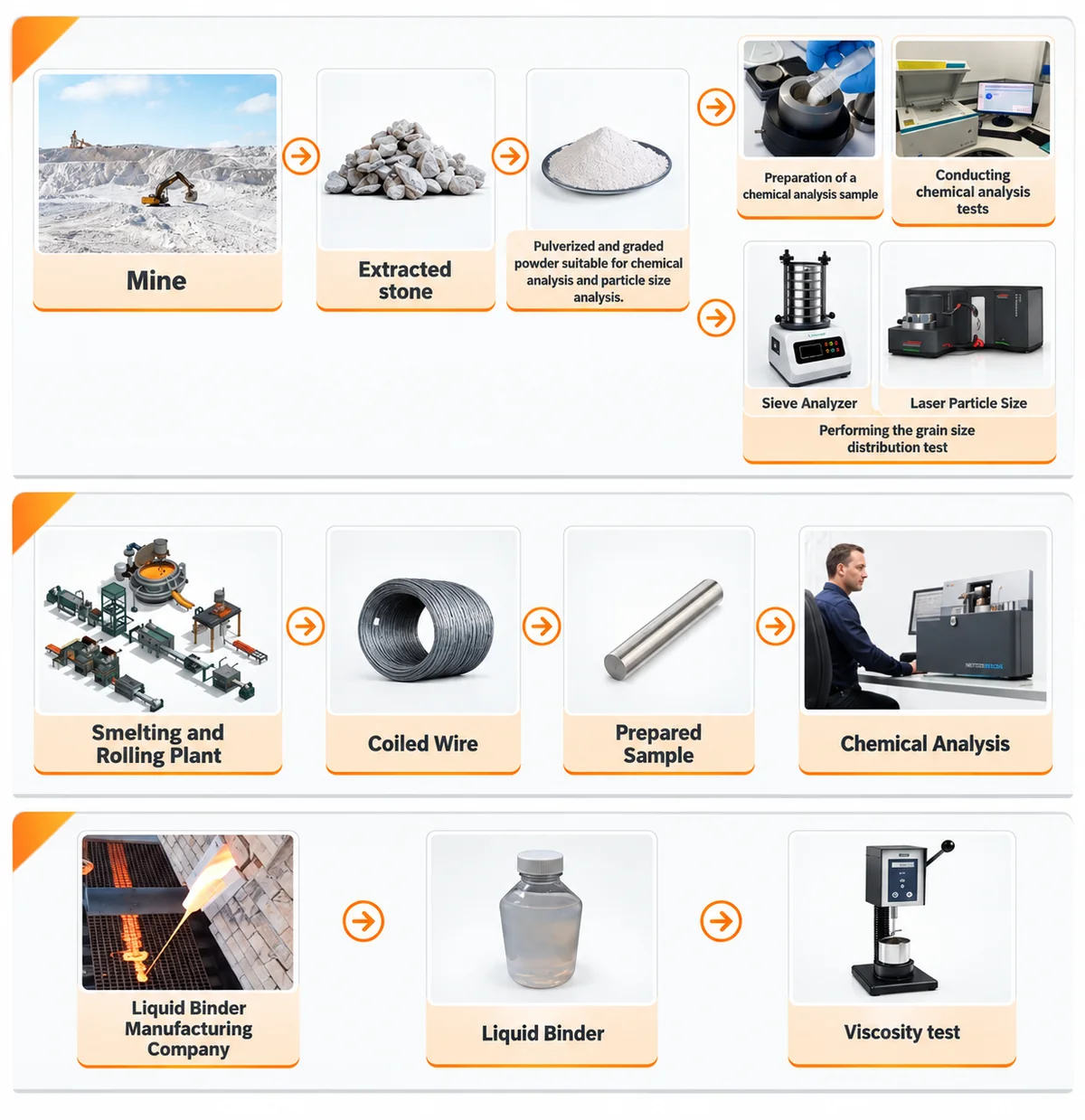
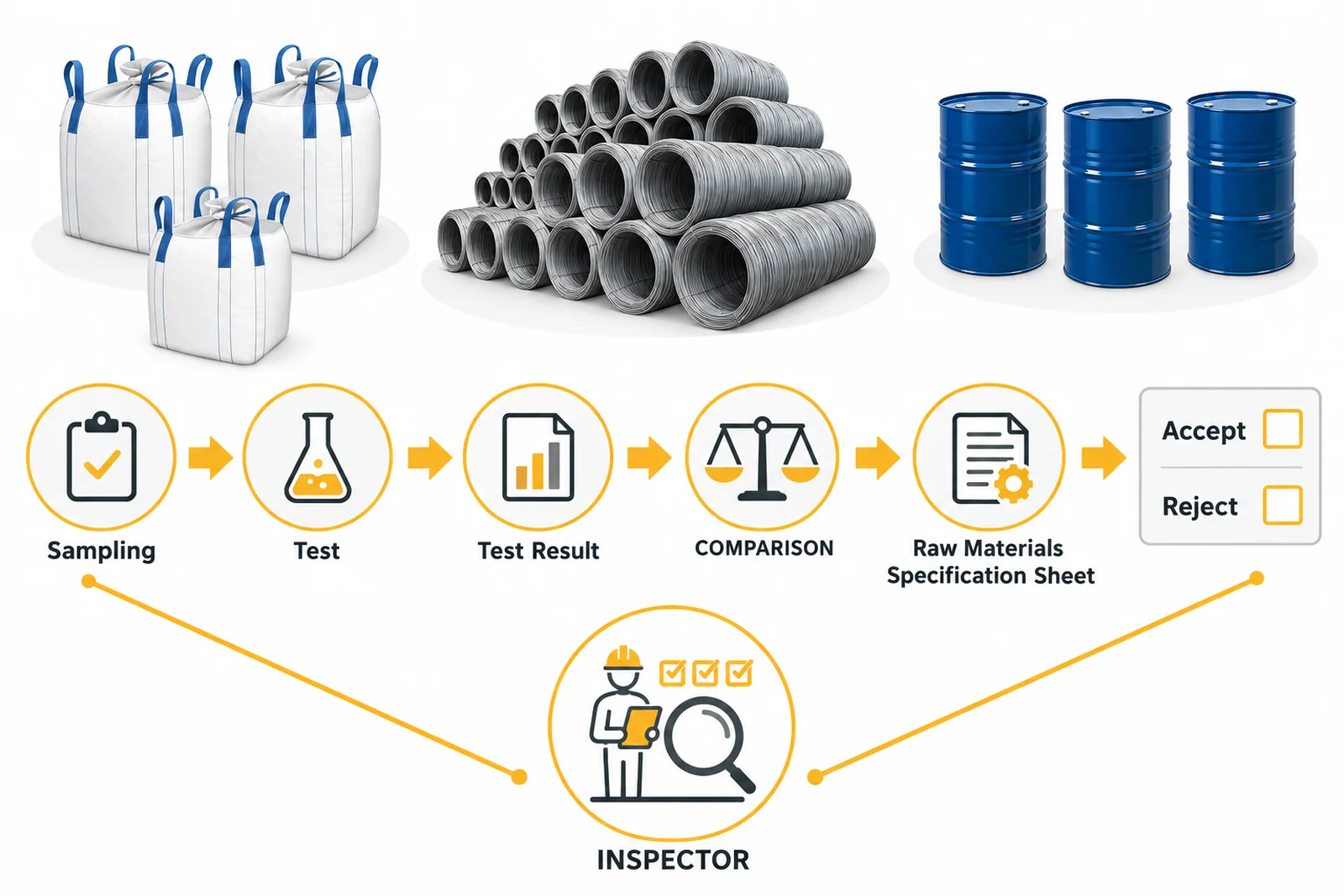
The documented approval process begins when the arrival of raw material is formally communicated to the laboratory through a test request. Laboratory personnel then sample the incoming material, the required analysis is assigned according to material type, and the results are reviewed before an approval decision is issued.
Laboratory Testing Is Only One Part of Approval
A laboratory result does not operate independently from the material specification. The laboratory determines the required analytical route and evaluates the test results, while the quality function is responsible for the final approval of incoming raw materials according to the applicable specifications and technical disposition rules.
The Approved Specification Is the Reference Point
Every incoming inspection system requires an agreed technical reference. Controlled material specifications should identify the material and provide the characteristics against which laboratory and quality results are compared.
The source procedures also recognize an important manufacturing reality: a locally available or alternative material may not always match an existing specification exactly. In this situation, a new specification should not be accepted only from paperwork. Its suitability for the intended electrode or flux formulation needs to be technically evaluated.
Existing Approved Material
- Verify material identity and traceability.
- Sample according to the relevant procedure.
- Perform the required laboratory analyses.
- Compare results with the approved specification.
- Release when the defined requirements are satisfied.
New or Different Material Specification
- Review the available technical specification.
- Determine the formulation or product in which the material may be used.
- Perform laboratory verification.
- Validate the material through controlled sample production where required.
- Confirm performance before routine approval.
Sampling Depends on the Material and Shipment Form
Sampling is part of the approval decision because the test result can only represent the shipment when the laboratory receives a suitable sample. The source procedures use different approaches for metallic materials, packaged powders and liquid silicates.
Wire and Strip
Purchased wire and flux-cored strip are linked to heat numbers. A sample is taken from each relevant heat for chemical analysis; the documented wire sampling example uses an approximately 50 cm piece cut from the middle of a coil.
Powders
Powder shipments may arrive in bags, drums or larger bulk packages. Random sampling is used across the shipment, followed by homogenization and controlled division to obtain the quantity required for analysis.
Liquid Silicates
For bulk liquid silicate deliveries, the documented method takes samples from both upper and lower portions of the tanker and combines them before testing.
Detailed rules for random, systematic and two-stage sampling, as well as mixing, crushing and sample division, are sufficiently extensive to justify a separate technical article and should form part of the laboratory sampling system.
Select the Analytical Method According to the Material
Different raw materials cannot be evaluated by a single laboratory method. The documented laboratory system combines instrumental and classical techniques according to the sample matrix and the characteristics that need to be measured.
| Material Group | Documented Verification Methods | Primary Control Purpose |
|---|---|---|
| Wire | XRF, carbon-sulfur analysis, gravimetric methods and atomic absorption where applicable | Verification of chemical composition |
| Mineral and Metallic Raw Materials | XRF, carbon-sulfur analysis, gravimetry, titrimetry, atomic absorption and laser or sieve particle-size analysis as applicable | Chemical composition and particle-size control |
| Electrode Coating and Welding Flux Powders | XRF, carbon-sulfur analysis and sieve particle-size control | Chemical and granulometric verification |
| Soluble Silicates | Gravimetry, titrimetry and viscometry | Chemical and binder-property verification |
| Organic Materials | Mainly physical inspection in the documented procedure | Suitability for the intended coating system |
Imported Raw Materials Require the Same Approval Logic
The source procedure applies the same fundamental approval route to imported and locally sourced materials. Technical specifications and shipment information are communicated to the relevant functions and the material is evaluated through the established quality system.
There are cases in which a particular imported material cannot be fully tested by the manufacturer's own laboratory. The documented procedure allows the final technical decision to use the supplier's certificate or analysis sheet, or results obtained from an external laboratory, as supporting evidence for acceptance or rejection.
Supplier Documentation Is Evidence, Not a Universal Replacement for Verification
Supplier specifications and analysis certificates are part of the technical record. Where the required testing can be performed internally, the normal sampling and verification process remains the primary route. External or supplier results become especially important where the required analysis is not available in-house.
What Happens When a Raw Material Is Nonconforming?
Under the normal approval route, purchased material that does not meet its required specification is rejected and removed from the plant by the supplier. The source procedures, however, also define controlled technical routes for exceptional cases where a material is urgently required or where an alternative specification needs evaluation.
Normal Disposition
- Identify the nonconforming material.
- Prevent unintended use.
- Document the analytical result and disposition.
- Reject or return material that cannot be technically accepted.
Controlled Technical Evaluation
- Review the deviation against the intended formulation.
- Modify the formulation where technically necessary.
- Produce a controlled trial or pilot batch.
- Perform welding and relevant weld-metal tests.
- Approve use only for the defined application if results are acceptable.
The important distinction is that exceptional use is a technical decision, not an uncontrolled release. If the material creates a production or product-quality problem during the evaluation, further consumption can be stopped.
Raw Material Approval Requires Clear Responsibilities
The documented system separates responsibilities between warehouse, quality, laboratory, planning and foreign procurement functions. This separation helps preserve traceability and prevents the material approval decision from depending on a single uncontrolled activity.
Controls incoming material identification, labeling and communication of material arrival to Quality Control.
Issues test requests, provides specifications and makes the final material approval or technical-use decision.
Determines appropriate test methods, performs or supervises analyses and compares results with the approved specification.
Communicates the required raw-material specification information to the quality function.
Transfers supplier specifications and imported-material receiving information to the relevant departments.
Identification, Records and Traceability
Raw material control is incomplete if the analytical result cannot be connected to the physical material in storage. The source procedures use internal material identification, heat-number traceability for metallic materials, analysis-sheet references and controlled records to maintain this connection.
Supplier specifications, laboratory reports, material-quality results and approved specifications are retained as controlled records. The documented retention period varies according to record type, which reinforces the need for a defined document-control policy within the manufacturer's quality management system.
Traceability Should Answer Four Questions
What material is this? Which shipment or heat did it come from? What test result belongs to it? What was the final technical disposition?
A Practical Raw Material Quality Control Framework
| Stage | Required Control | Typical Output |
|---|---|---|
| Specification | Define the material and its approved technical requirements | Controlled material specification |
| Receiving | Identify shipment, supplier documentation and traceability information | Incoming material notification and identification |
| Sampling | Use a representative method appropriate to wire, strip, powder or liquid binder | Laboratory sample linked to the shipment |
| Testing | Select the required chemical, particle-size or physical verification methods | Laboratory test results |
| Review | Compare results with the approved specification | Technical evaluation |
| Disposition | Approve, reject or route the material through controlled technical evaluation | Documented release or nonconformity decision |
| Traceability | Maintain the connection between material, result and final disposition | Controlled quality record |
Need to Develop or Improve Raw Material Specifications and Incoming QC?
WESPEC supports welding consumables manufacturers with raw material specifications, supplier-material evaluation, laboratory control plans, pilot validation and technical quality procedures for covered electrodes, welding fluxes, flux-cored wires and welding wire production.