
Reliable raw material analysis connects representative sampling, controlled preparation, a suitable analytical method and verified instrument performance. This guide explains XRF, atomic absorption, combustion carbon and sulfur analysis, and complementary viscosity checks used to qualify welding-consumable raw materials—with calibration, error investigation and release decisions built into each method.
Why Chemical Analysis of Raw Materials Matters
Welding consumables are manufactured from combinations of raw materials selected to provide specific metallurgical, chemical and operating characteristics. The composition of those raw materials therefore becomes part of the control of the finished consumable.
Mineral powders such as rutile, ilmenite, silicates, calcite and dolomite may form part of electrode coatings, flux-cored wire fills or submerged arc welding flux systems. Ferroalloys and metallic powders provide alloying, deoxidizing and other metallurgical functions, while wire and strip contribute directly to the metallic chemistry of the consumable.
A material can have the correct commercial name, acceptable appearance and supplier documentation while its actual composition still differs from the approved specification. Chemical verification therefore provides an independent technical basis for the material approval decision.
Chemical Analysis Supports a Production Decision
The objective is not simply to generate laboratory numbers. The analytical result must establish whether the tested material complies with its approved specification and is suitable for release to production.
How to use the equipment examples
The detailed examples below are drawn from the 16-page laboratory instruction QWI-LA-02, revision 00. They describe a particular installed laboratory: Varian SpectrAA 220, ELTRA METALYT 100/1000 RF, an XRF system and a VT02 viscometer. Historical ranges, tolerances and maintenance intervals are identified as local examples. A current approved method, instrument manual and valid reference-material certificate govern actual testing.
From Incoming Material to Analytical Decision
Chemical analysis is one stage of a larger quality-control process. The reliability of the final result depends on every step that occurs before and after the instrument measurement.
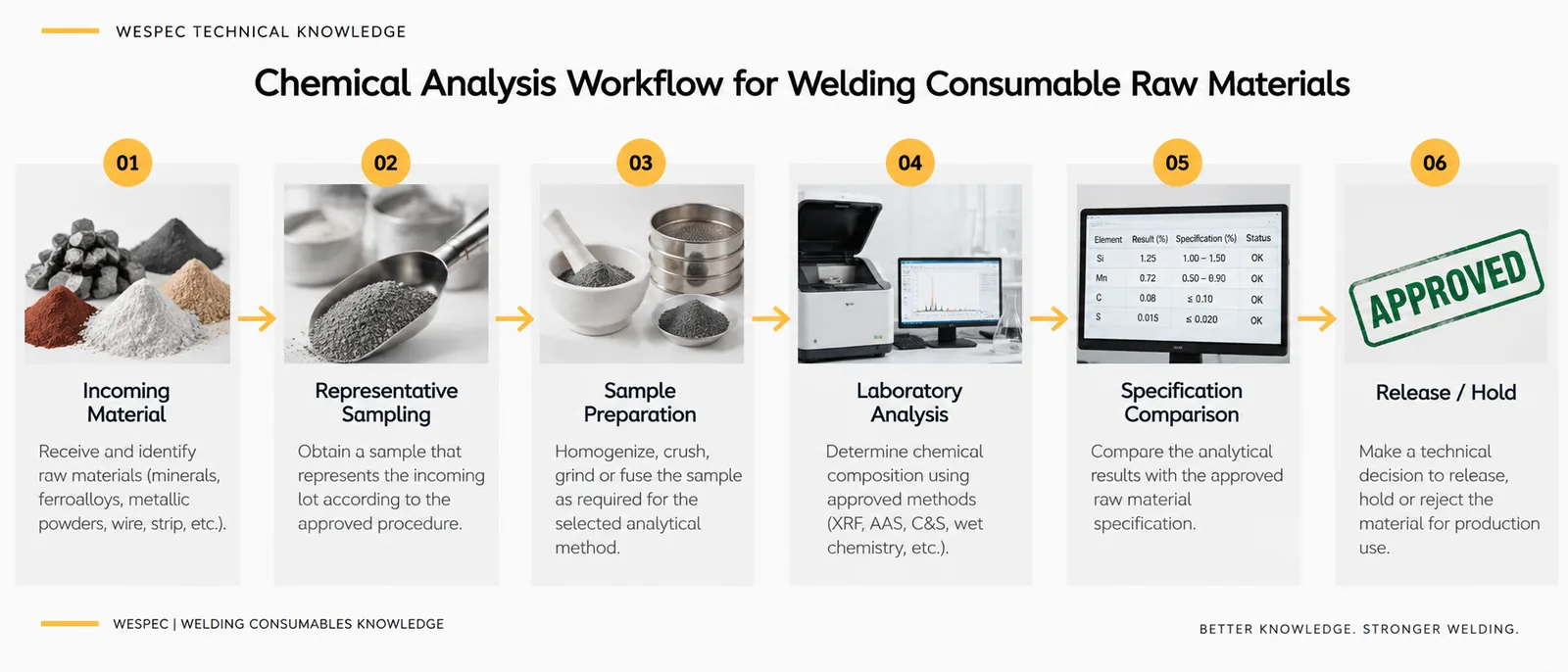
Make the result traceable from the first sample to the final decision
Assign the supplier lot, sampling record, laboratory sample and test portion a linked identity. Record the preparation route, original mass, final volume or dilution, instrument ID, analytical program, calibration version, reference-material batch, check results and analyst. A result should remain traceable to the instrument condition at the time of measurement, including any reslope, drift update or maintenance.
The laboratory instruction itself is controlled by document code, revision, issue date and approvals. Apply the same control to working methods and forms: obsolete instructions must not silently remain in use after an instrument, reference material or calculation changes.
Selecting the Analytical Method by Material Type
No single analytical technique is suitable for every material used in welding consumables manufacturing. The method should be selected according to the material matrix, physical form, elements of interest, concentration range and required accuracy.
| Material | Typical Preparation | Applicable Analytical Methods | Main Objective |
|---|---|---|---|
| Mineral Powders | Homogenization and, where suitable, fused glass bead or pressed preparation | XRF, wet chemistry, AAS, C&S where applicable | Major and minor chemical constituents |
| Ferroalloys & Metallic Powders | Grinding and pressed pellet preparation or another matrix-appropriate method | XRF, C&S and complementary methods | Alloying elements and controlled impurities |
| Wire & Metallic Samples | Suitable metallic surface or prepared metallic sample | XRF, spark emission, C&S or wet methods | Wire chemistry and heat verification |
| Soluble Silicates | Liquid or appropriately prepared soluble sample | Wet chemistry and relevant physical-property measurements | Composition and binder consistency |
Analytical selection should also consider concentration range. A technique suitable for a major constituent may not provide sufficient sensitivity for a low-level element, while a method optimized for trace analysis may not be the most practical choice for routine major-element control.
Silicate Binder Quality Control
Working with sodium or potassium silicate binders? Explore sampling, chemical composition, solids content, density, viscosity, storage and controlled production dosing in the dedicated guide.
Read the Full Silicate Binder Quality Control Guide →Choose the measurand before choosing the instrument
Use XRF for a validated set of elements or calculated oxides in an appropriate solid matrix; AAS for selected elements in a prepared solution; and combustion analysis for total carbon and sulfur within a validated matrix and range. Rotational viscosity measures a physical characteristic and complements chemical analysis; it does not identify elemental composition.
A low solution concentration reported by AAS is not automatically a low concentration in the original powder. Likewise, an XRF oxide calculation is not a direct determination of the mineral phase. Define the reporting basis—element or oxide, mass percent or mg/kg, dry basis or as received—before comparing results with a purchase specification.
Sample Preparation Is Part of the Measurement
Instrumental accuracy cannot compensate for poor sample preparation. A laboratory sample must be sufficiently homogeneous and physically compatible with the analytical technique being used.
Mineral Powders and Welding Flux Materials
For many mineral materials, fusion provides an effective preparation route for XRF analysis. The prepared sample is mixed with a suitable flux and melted to form a homogeneous glass bead.
This approach can reduce the influence of mineralogical and particle-size differences that may otherwise affect direct powder measurements.
Ferroalloys and Metallic Powders
Ferroalloys and metallic powders may require grinding before preparation because coarse or non-uniform particles can compromise analytical repeatability. Depending on the validated laboratory procedure, the prepared material may be pressed into a stable pellet for XRF measurement.
Preparation Principles
- Prevent cross-contamination
- Achieve adequate sample homogeneity
- Control particle-size effects
- Use clean preparation equipment
- Select preparation according to matrix
- Preserve the composition of the original sample
- Follow the validated analytical procedure
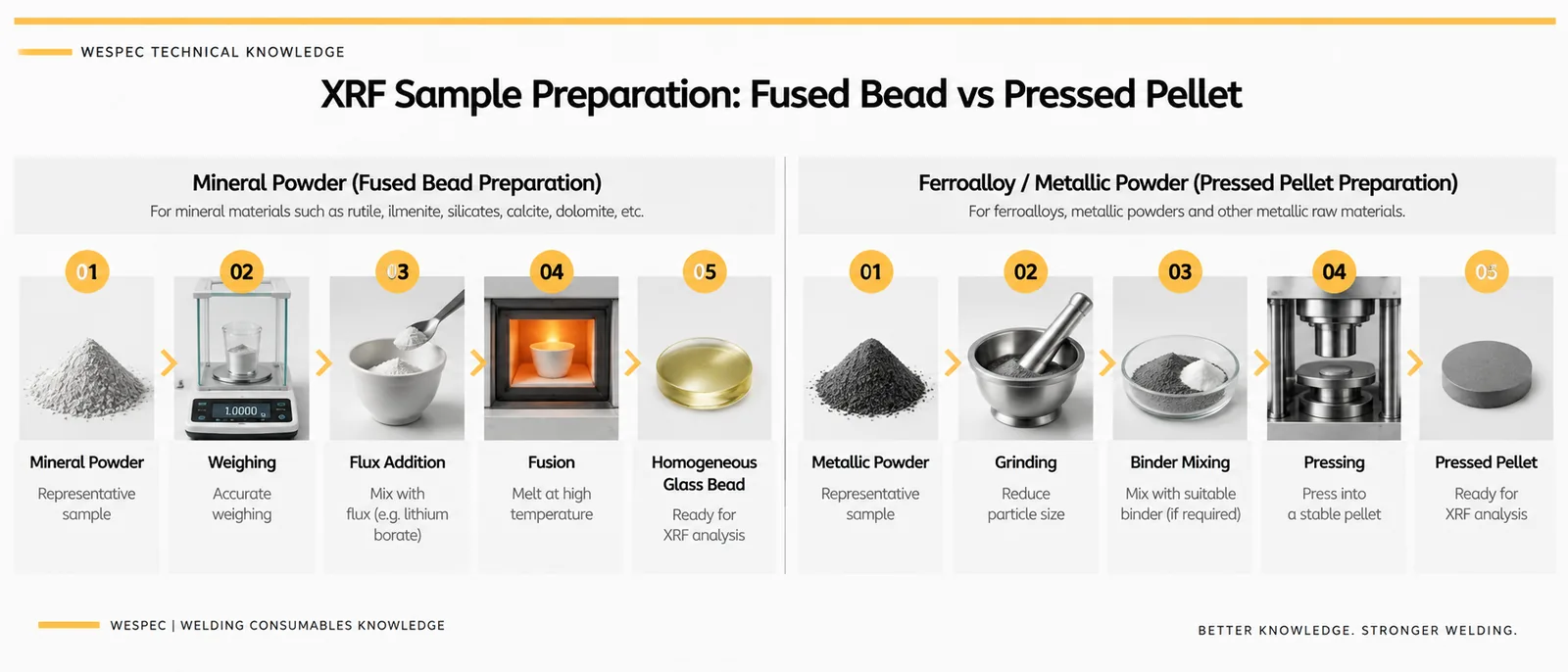
Method-specific preparation controls
- XRF: keep grinding, binder or fusion-flux ratio, dilution, pellet pressure and surface preparation consistent with the calibration method. Assess oxidation and volatilization before applying fusion to a new material.
- AAS: establish complete dissolution or a clearly defined extraction, preserve the analyte, use clean volumetric equipment, and record reagent blanks, final volume and every dilution.
- Carbon and sulfur: weigh a representative test portion, use the approved crucible and accelerator, and control their blank contribution. Metal chips, wire pieces, rings and powders may all be measurable, but their combustion behavior must still be validated.
- Viscosity: homogenize the liquid without introducing persistent bubbles and control its temperature and conditioning history.
XRF: Preparation, Matrix Corrections and Calibration
X-ray fluorescence relates the characteristic X-ray spectrum of a prepared material to its elemental composition. Rutile, ilmenite, silicates, calcite, dolomite, barium-bearing materials, ferroalloys and metallic powders require matrix-appropriate preparation and calibration. The wavelength identifies the emitting element; the measured intensity is related to its concentration through an analytical model.
From excitation to an analytical program
In the wavelength-dispersive arrangement described in the laboratory instruction, an X-ray tube excites the sample, a dispersing optical system separates spectral lines, and the detector measures selected line intensities. Conceptually, intensity is a function of concentration, I = f(C), while characteristic wavelength depends on atomic number. Absorption, enhancement and overlapping lines mean that intensity is not universally proportional to concentration.
The documented installation uses an Instrument Controller System (ICS) connected to a Spectrometer Automation System (SAS); instrument control and data processing are separate functions. This architecture is specific to the installation. Its instruction refers operators to the XRF 386 Reference Guide for detailed calibration commands; those commands are not reproduced in the supplied document.
Build a calibration for the material family
- Create a dedicated analytical program for the matrix and required elements.
- Select reliable standards covering the expected concentrations and composition variations, prepared by the same route as the unknowns.
- Measure the reference materials and fit each element's intensity–concentration relationship with the required corrections.
- Define the drift-monitor samples and their reference responses.
- Analyze a suitable reference material as an unknown and compare the result with its assigned value before releasing production results.
The local instruction gives approximately five standards as an example for a simple sample and as many as about 100 for a complex calibration with interacting constituents. These are examples of calibration complexity, not minimum or mandatory counts. The number, range and distribution of standards must support the selected model. Reference-material uncertainty and preparation variability limit the achievable result quality.
Three corrections that must be considered separately
| Correction | Cause and practical control |
|---|---|
| Spectral overlap | Insufficient separation allows a neighboring element’s line to contribute to the analyte signal. Select appropriate lines and validated overlap coefficients. |
| Interelement or matrix correction | Changes in other constituents alter absorption and enhancement, changing sensitivity. This is especially important for major constituents and compositionally variable matrices. |
| Background correction | Changes in background shift the apparent baseline. The local instruction particularly emphasizes trace measurements, light matrices and approximately 1–100 ppm work. Measure and model the relevant background rather than treating it as a fixed universal value. |
The legacy workflow addresses significant overlap and background effects before the more complex matrix-sensitivity correction. Modern software may solve these effects together; follow the validated program instead of assuming the same mathematical sequence works for every system.
Drift correction and independent verification
Periodically remeasure stable monitor samples representing the low and high ends of the working response. Apply the approved drift correction update, then verify the result with a suitable reference material measured as an unknown. A drift update restores response within an established calibration; it cannot make an unsuitable matrix model valid. Recalibration is necessary when checks remain unacceptable or the method, preparation or hardware changes materially.
Historical XRF error bands
The following table reproduces the local empirical bands. C denotes the measured element concentration in mass percent. Error values are absolute percentage points, not relative percentages, and are not purchase limits or a substitute for measurement uncertainty.
| Concentration C, mass % | Local normal error | Local maximum acceptable error |
|---|---|---|
| 10 < C < 90 | ±0.5 | ±1.0 |
| 1 < C < 10 | ±0.1 | ±0.5 |
| 0.1 < C < 1 | ±0.05 | ±0.1 |
| 0.01 < C < 0.1 | ±0.005 | ±0.02 |
| 0.005 < C < 0.01 | ±0.0003 | ±0.002 |
Do not turn capability statements into universal detection limits
The instruction mentions both approximately 10 ppm under favorable corrected conditions and 0.005% (50 ppm) in its error discussion. These statements do not establish one validated detection limit. Its broad element-coverage claim also excludes H, He, Li, Be, noble gases and some short-lived elements; actual coverage depends on the specific optics, atmosphere, detector, matrix and method. Validate each required element and range, and define boundary handling for the open intervals in the historical error table.
AAS: Solution Preparation, Calibration and Matrix Control
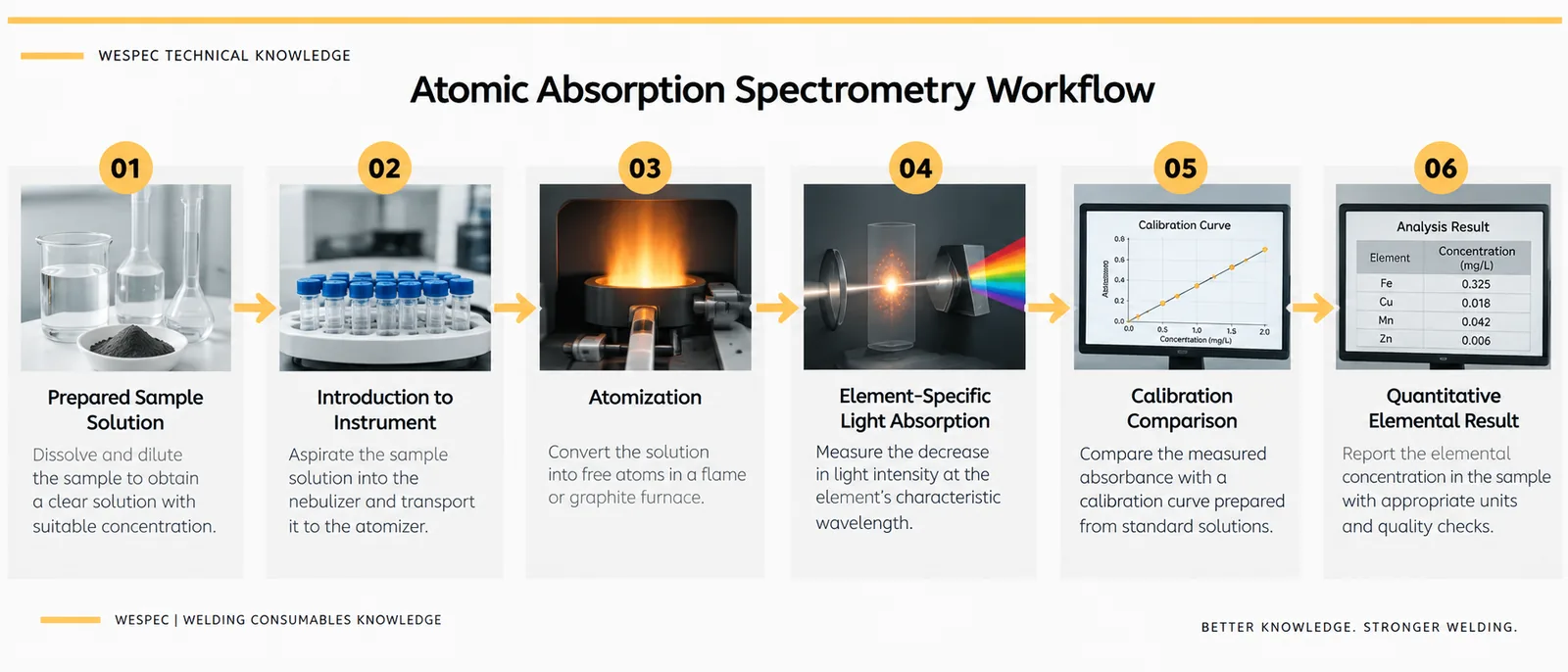
Flame atomic absorption spectrometry measures selected elements after a representative test portion has been converted into a suitable solution. In the documented Varian SpectrAA 220 installation, four lamp positions accommodate element-specific hollow cathode lamps. The solution is nebulized into the flame; solvent evaporation, vaporization and atomization produce atoms capable of absorbing characteristic radiation.
What each component contributes
A hollow cathode lamp contains an element-bearing cylindrical cathode and an anode in a glass envelope filled with a gas such as argon or neon. The instruction lists nickel, tungsten, tantalum or zirconium as possible anode materials and illustrative lamp characteristics of 100–400 V and 3–10 mA. These are descriptive figures, not settings for every lamp. Use the current and wavelength specified for the selected element and lamp.
The atomizer comprises the nebulizer and burner assembly. The local equipment uses air–acetylene or nitrous oxide–acetylene flames, with approximately 10 cm and 5 cm burner slots respectively. A monochromator isolates the analytical wavelength, a photomultiplier converts light into an electrical signal, and source modulation helps distinguish lamp radiation from flame emission.
Absorbance is expressed as A = log10(I0/It), where I0 is the incident/reference intensity and It is transmitted intensity. This avoids the ambiguous intensity notation in the legacy instruction. Concentration is obtained from calibration, not from absorbance alone.
Startup and preparation for measurement
- Confirm the approved instrument and gas-supply setup, extraction, burner and method before operation; follow the instrument's ignition and shutdown sequence.
- Start the instrument and computer, load the appropriate method, and confirm the element lamp, wavelength, slit and lamp current.
- Check burner alignment using the prescribed alignment card and confirm solution uptake, nebulizer condition and stable response.
- Prepare standards and the reagent blank in a matrix compatible with the sample solutions.
- Calibrate and verify before measuring unknowns; retain the method settings and check results with the batch.
External calibration, zero and reslope
Prepare calibration solutions from suitable certified solutions or correctly characterized solid standards, recording dissolution and dilution. The local instruction prefers an absorbance region of 0.1 < A < 0.4; confirm the usable linear range for the actual analyte and matrix. Dilute over-range samples using the validated procedure rather than extrapolating.
The source describes zeroing with distilled water. Where acids, reagents or dissolved salts affect the blank response, use the method's matrix-appropriate reagent blank. The instruction calls for a reslope at each use because gas pressure, air supply and temperature can change sensitivity. A Failed Reslope requires investigation and recalibration before reporting unknowns; repeated failed checks are not resolved by simply accepting a new slope.
Standard addition for matrix-affected solutions
Add known analyte amounts to equivalent portions of the same prepared sample. Keep final volumes and matrix composition equivalent, or account explicitly for dilution. For a linear, blank-corrected single addition, x/(x + a) = c/b, giving x = ac/(b − c), where x is the original concentration in the measured solution, a is the added concentration, c is the unspiked signal and b is the spiked signal. Multiple additions provide a stronger check of linearity. Standard addition can compensate for certain matrix effects; it does not repair incomplete dissolution, contamination or an inappropriate wavelength.
Sensitivity, detection capability and reporting units
The characteristic concentration is the concentration producing 0.0044 absorbance, approximately 1% absorption. It is not a detection limit. The legacy text separately mentions a two-standard-deviation detection criterion and a broad sensitivity span of 3 × 10⁻⁴ to 20 ppm; neither is a universal performance specification. Establish detection and quantification limits with the actual blank, matrix and approved calculation.
AAS commonly reports the measured solution in mg/L. The local text also uses ppm; that equivalence requires an appropriate dilute-solution density assumption. To report an original solid sample, use mg/kg = (Csample − Cblank) × V × D / m, with C in mg/L, final volume V in L, subsequent dilution factor D, and test-portion mass m in kg. Apply the defined moisture-basis correction separately.
Errors and acceptance of the measurement
Investigate instrument faults and alignment, lamp output, uptake variation, flame conditions, calibration-solution preparation, sample dissolution, dilution and matrix interference. Match standard and sample matrices where appropriate and validate any change of flame or fuel/oxidant conditions.
A local tolerance is not a trace-analysis specification
For concentrations above 0.1 ppm, the instruction lists a maximum error of ±0.1 ppm. This absolute local criterion can be too broad near its lower end and cannot establish suitability for every raw-material limit. Set acceptance limits from the intended measurement, reference-material uncertainty and demonstrated method performance.
Combustion Carbon and Sulfur Analysis: Calibration and Gas-System Control
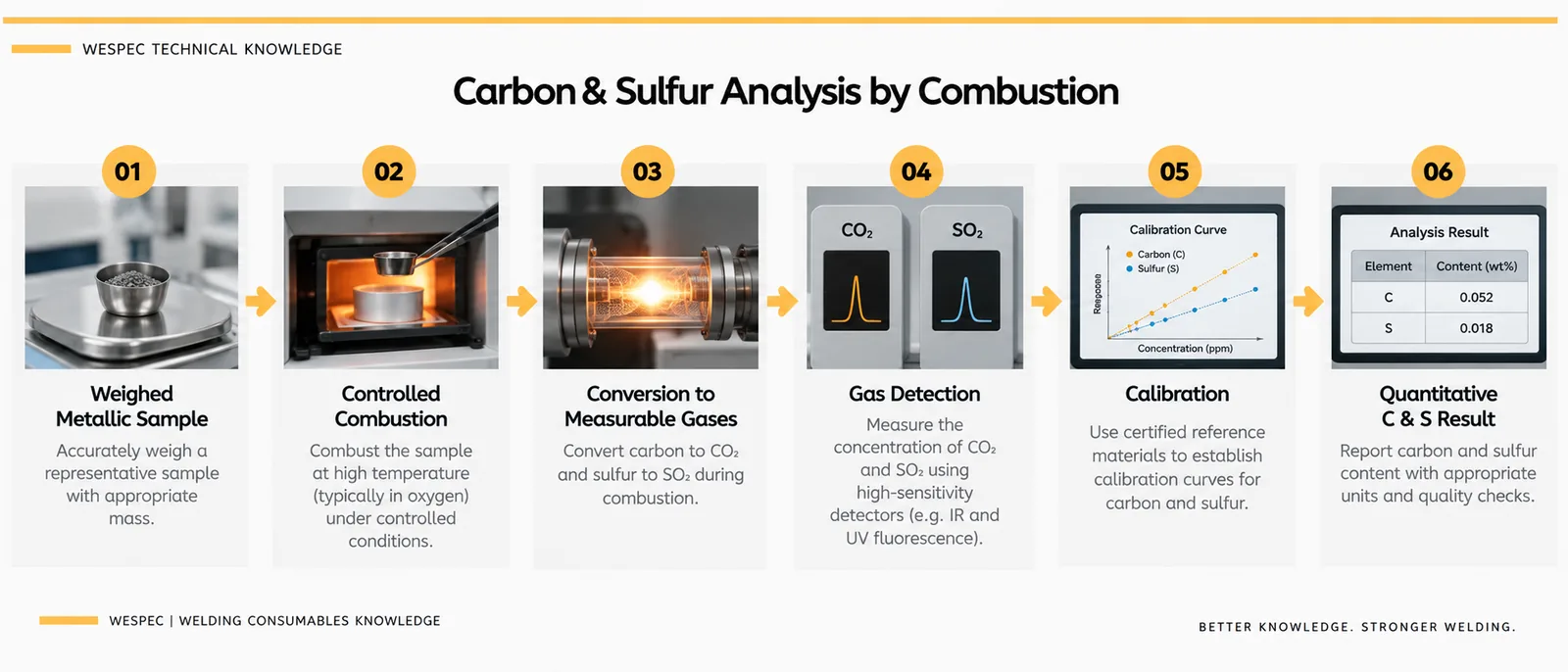
Combustion analysis determines carbon and sulfur by converting them into gases and measuring their infrared absorption. It is particularly useful for metallic powders, ferroalloys and wire materials; cement, coal and other matrices require appropriate validated programs. The supplied instruction describes an ELTRA METALYT 100/1000 RF installation.
Weighing, combustion and infrared detection
Weigh a representative portion and enter its actual mass. In an oxygen atmosphere, combustion releases carbon mainly as CO2 and sulfur as SO2. Selective infrared channels measure the gas signals; the integrated signals and sample mass are used to calculate mass fractions. Enter approved blank corrections where required. Correct mass normalization does not make the result independent of combustion completeness or sample size.
The legacy document describes an approximate combustion temperature of 1600°C, depending on sample type, mass and accelerator. An induction furnace does not establish one universal fixed sample temperature. Select a matrix-appropriate accelerator and confirm complete release; a preparation suitable for carbon alone may not be suitable for simultaneous sulfur determination.
| Documented characteristic | Historical installation value / qualification |
|---|---|
| Nominal C and S range | 0.0001–100% for each; quoted sensitivity 0.0001%. This is not evidence that one calibration covers the entire range. |
| Quoted accuracy | 0.0002% or 0.5% of sample concentration; the document does not define a complete selection rule for the alternatives. |
| Typical analysis time | 30–40 seconds; total cycle also includes preparation and checks. |
| Typical test-portion mass | 0.2–0.7 g, adjusted to the material and validated method. |
| Induction frequency | 13.6 MHz. |
| Electrical supply | 220 V, 50–60 Hz, 10 A, as recorded for the installation. |
| Ambiguous furnace-power entry | The source prints “Max. 21 VA”; this is not a reliable installation specification. Confirm the original equipment rating. |
| Oxygen | 99.5% purity and approximately 1.5 bar (22 psi) in the specification table. The narrative gives about 2 bar with a 1.5–2.5 bar supply range and approximately 0.5 bar downstream. These refer to different circuit locations and must not be interchanged. |
Gas conditioning and maintenance affect the result
The described inlet purification column removes CO2 and water from oxygen. Its upper portion contains CO2 absorbent and its lower portion contains water absorbent. Magnesium perchlorate is identified as a drying agent; sodium-hydroxide-based material or soda lime is described for CO2 removal. An indicator change is used to recognize exhausted absorbent in the applicable cartridge. Renew consumables according to the approved instrument procedure.
After regulation and combustion, dust and moisture are removed before the gases reach the measuring cells. The local flow description places SO2 measurement before catalytic conversion of residual CO to CO2 and subsequent CO2 measurement. It names copper oxide or platinum catalyst and lists glass wool, cellulose and SO3 trapping media in different passages. Those passages are not a complete unambiguous cartridge map: identify each trap and its replacement material from the actual instrument manual rather than interchanging media.
Pressure regulation reduces the influence of supply fluctuations; leaks, depleted absorbers, moisture carryover, dust loading and incomplete combustion can still bias a result. Record trap changes and demonstrate acceptable blanks and reference checks after maintenance.
Channel calibration and stored factors
- Select the required channel: Low Carbon, Carbon or Sulfur.
- Select a reference material with a suitable matrix and concentration and confirm its current assigned value.
- Select the intended calibration-factor position. The legacy installation provides eight stored factors per channel for different concentration levels or applications.
- Enter the certified concentration as the set point and measure repeated portions. The instruction permits up to ten analyses for a calibration.
- Review repeatability and agreement with the reference value using predefined criteria; retain all original readings and the reason for any excluded result.
- Save the calculated factor, verify it with an independent check where practical, and confirm the correct factor is selected for unknowns. Stored factors remain in memory after shutdown.
Do not improve calibration by selecting only convenient readings
The legacy procedure discusses deleting discrepant results and its special “analysis 0” set-point entry. Close grouping alone does not establish accuracy. Exclude only readings with a documented technical reason under the approved procedure, and do not delete valid results merely because they lie above or below the desired value. Confirm how the actual software treats the set-point entry before calculating a factor.
Historical carbon and sulfur error bands
The source groups its empirical errors as follows. Concentrations and errors are mass percent and absolute percentage points respectively. Its printed interval symbol is C even though the table addresses both carbon and sulfur. Use analyte-specific validation rather than assuming identical performance.
| Concentration, mass % | Local normal error | Local maximum acceptable error |
|---|---|---|
| 0.001 < C < 0.01 | ±0.0003 | ±0.002 |
| 0.01 < C < 0.1 | ±0.005 | ±0.02 |
| 0.1 < C < 1.0 | ±0.03 | ±0.1 |
| 1.0 < C < 10 | ±0.05 | ±0.2 |
| 10 < C < 100 | ±0.5 | ±1.0 |
Reference-material inventory recorded in the laboratory instruction
These historical inventory values are reproduced for traceability, not as replacement certificates or current procurement recommendations. Verify the exact designation, batch, certificate, assigned values and uncertainty before use. A material without a supported assigned value is not automatically suitable for primary calibration.
| Reference designation | C, mass % | S, mass % | Certificate status in source |
|---|---|---|---|
| CRM 287-1 | 0.016 | 0.0014 | Present |
| ZRM 286-1 | 0.100 | 0.280 | Ditto: present |
| 215/3 | 0.91 | 0.031 | Ditto: present |
| B.C.S 163/2 | 1.26 | 0.022 | Present |
| 428-1 | 2.77 | 0.104 | Absent |
| CRM 489-1 | 2.860 | 0.155 | Present |
| 484-1 | 3.20 | 0.230 | Ditto: present |
| ZRM 476-2 | 3.43 | 0.05 | Absent |
| BCS 431/2 | 0.0249 | 0.0065 | Not stated |
| BCS 451/1 | 0.051 | 0.014 | Not stated |
| BCS 409/2 | 0.086 | 0.0179 | Not stated |
| 237/2 | 0.122 | 0.031 | Not stated |
| 504-5 | 0.303 | 0.012 | Not stated |
| 435/1 | 0.52 | 0.031 | Not stated |
| BCS 404/2 | 0.696 | 0.0228 | Not stated |
| NCS HC13201 | 0.91 | 0.030 | Not stated |
| FB2 | 2.114 | 0.128 | Not stated |
| ZRM 4467-3 | 3.390 | 0.0491 | Not stated |
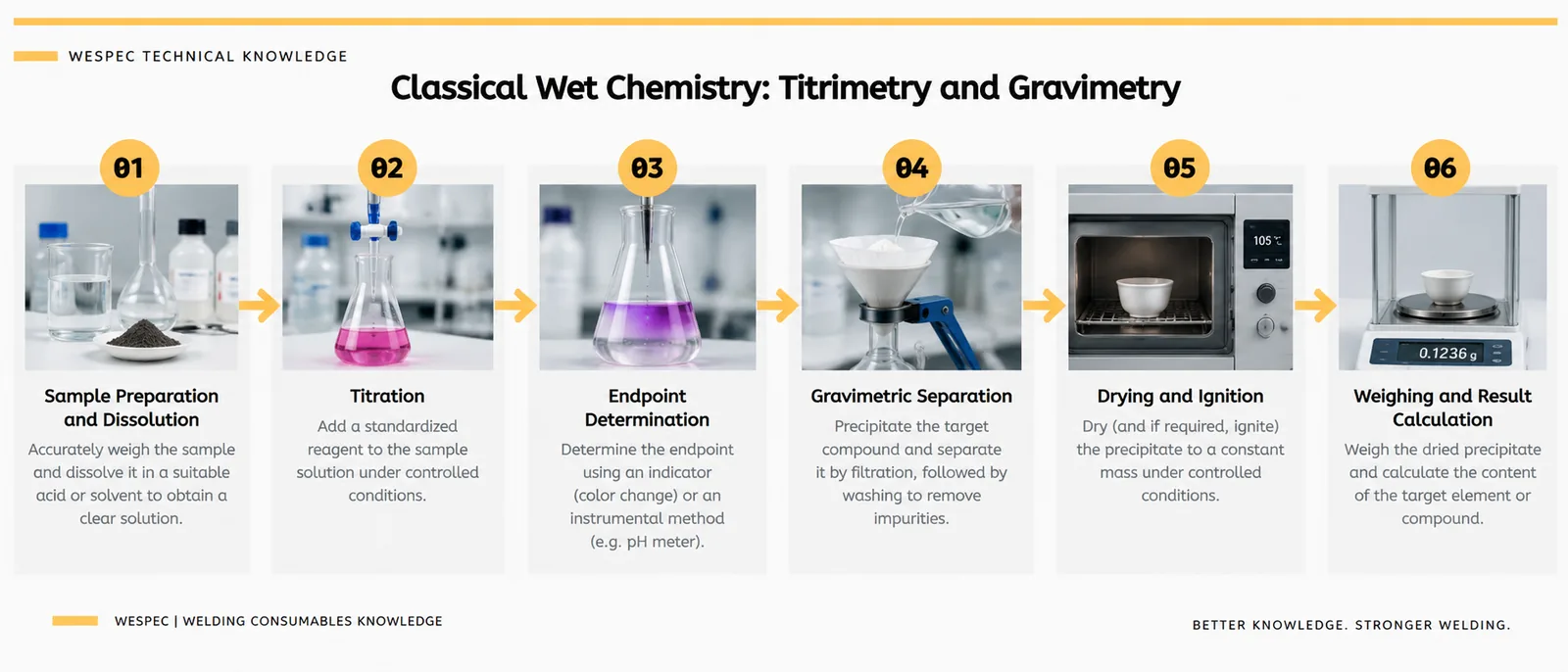
Wet Chemistry Still Has an Important Role
Modern instrumental techniques do not eliminate classical analytical chemistry. Depending on the material and the parameter being measured, titrimetric and gravimetric methods remain useful analytical tools.
Titrimetry
The analyte is determined through a controlled chemical reaction with a standard solution. Standardization, reaction conditions and endpoint determination influence result quality.
Gravimetry
The constituent of interest, or a chemically related compound, is isolated and determined by mass under controlled analytical conditions.
Complementary Verification
Classical methods can provide an independent analytical route when an instrumental result requires confirmation using another measurement principle.
Apply the same measurement controls to classical methods
The supplied calibration instruction does not contain a complete titration or gravimetric test method. Its relevant principles—controlled standard preparation, traceable mass and dilution, matrix compatibility, verification and documented errors—also apply here. Do not infer a titrant, endpoint or digestion recipe from an instrumental calibration section.
For titrimetry, standardize the titrant against an appropriate reference, run the method blank, verify volumetric delivery and control endpoint and reaction conditions. For gravimetry, control precipitation or isolation, washing, drying or ignition, cooling and weighing according to the method. Record balance verification and any temperature-dependent steps. These are complementary laboratory controls, not device-specific procedures supplied by QWI-LA-02.
Calibration, Verification and Laboratory Records
Calibration establishes the relationship between reference values and instrument response. Verification checks whether a defined performance requirement is met. Adjustment changes the measuring system; drift correction updates its response within an established model. Keep these activities distinct in the record, even where a legacy instruction calls all of them “calibration.”
A practical instrument-by-instrument control plan
| Equipment | Controls described in the source | When the check fails |
|---|---|---|
| SpectrAA 220 AAS | Standards for each new method; reslope at each use; blank, flame, alignment and matrix checks. | Investigate standards, sample preparation and instrument response; recalibrate after Failed Reslope. |
| XRF | Matrix-specific calibration; regular drift-monitor checks spanning the response; reference sample measured as unknown. | Investigate preparation and corrections; update drift only within the valid method, otherwise recalibrate. |
| ELTRA C&S | Select and validate the appropriate channel/factor; reference-material repetitions and gas-system/blank checks. No fixed calendar interval is specified. | Review combustion, traps, oxygen, blanks, mass and factor selection before restoring the calibration. |
| VT02 viscometer | Known-viscosity liquid checks approximately every three months with the correct rotor, container and conditions. | Investigate temperature, geometry and setup; seek qualified service if performance remains unacceptable. |
These are the historical local frequencies, not universal mandatory intervals. Establish the current schedule from risk, use, stability history, maintenance and method requirements. A calendar-valid label does not override a failed daily or batch check.
Reference-material and measurement records
- Reference designation, batch, certificate, assigned value and uncertainty; preparation, storage and expiry where applicable.
- Instrument and method version, channel or rotor, calibration range, reference readings and acceptance criteria.
- Original sample mass, volumes, dilution, blanks, temperature or other method settings as applicable.
- All replicate results, the calculated response or correction, pass/fail decision and technical reasons for exclusions.
- Maintenance performed, verification after intervention, analyst, reviewer and date of next required check.
Document review, responsibility and record retention
The instruction specifies six-month document reviews. Its AAS section assigns implementation to chemistry analysts and retains records for at least six months; the combined C&S/XRF/viscometer section assigns responsibility to the laboratory head and retains records for at least two years. These periods are local administrative requirements; the current laboratory should use an approved retention policy adequate for customer, quality-system and traceability needs.
A failed check can affect earlier results
Place affected materials on hold, identify the last demonstrated acceptable instrument state, and assess results generated since that point. Resolve the cause and verify performance before resuming release. Record any justified reanalysis and the impact on already reported results.
Common Causes of Unreliable Chemical Results
Analytical errors can originate before, during or after the actual instrument measurement. A practical laboratory system should therefore control the complete analytical chain.
| Source of Error | Potential Effect | Control Approach |
|---|---|---|
| Unrepresentative sampling | Laboratory result does not represent the incoming lot | Defined sampling plan and controlled sample division |
| Cross-contamination | Incorrect measured concentration | Clean preparation equipment and controlled handling |
| Poor homogenization | Variation between repeat measurements | Appropriate grinding, mixing and preparation |
| Matrix mismatch | Systematic analytical bias | Matrix-appropriate standards and validated corrections |
| Incorrect calibration range | Reduced reliability of calculated concentrations | Standards covering the expected analytical range |
| Instrument drift | Progressive change in analytical response | Routine verification, correction and recalibration |
| Incorrect sample preparation | Particle-size, surface or mineralogical effects | Method-specific preparation procedure |
Separate repeatability from correctness
Three tightly grouped readings may share the same bias. Independent reference checks, blanks, recoveries where applicable and comparison with another suitable method help reveal errors that replicate analysis alone cannot detect. Review units and calculations as carefully as the instrument: 0.005% equals 50 mg/kg on a mass basis, and an absolute error of 0.1 percentage point is different from a relative error of 0.1%.
For viscosity measurements, investigate temperature, bubbles, rotor selection and container geometry. Calibration cannot compensate for an unrepresentative test portion.
From Laboratory Result to Material Release
Chemical analysis becomes meaningful when the result is connected to a defined raw material specification and a controlled quality decision.
Suspicious or Abnormal Results
When an analytical result is suspicious or inconsistent with expectations, the cause should be investigated before a final disposition is made. Depending on the situation, this can involve verification of the analytical method, repeat analysis or repeat sampling.
If the selected method is unsuitable for the material, an appropriate alternative method may be required. Reference samples or external laboratory comparison can also help verify whether the measurement system is performing correctly.
Release requires a valid result and an applicable specification
Confirm sample identity, method suitability, calibration and verification status, reporting basis, units and the required decision rule before comparing results with the material specification. Historical instrument error tables are measurement examples, not raw-material acceptance limits. Near a specification boundary, apply the agreed treatment of measurement uncertainty rather than silently rounding to a passing result.
When chemistry complies but binder viscosity does not, assess that failure against its own approved limits. Record release, hold, conditional disposition or rejection with the authorized technical justification. Repeated testing must investigate a cause, not search for a convenient passing number.
Binder Viscosity and Complementary Quality Control
Elemental composition does not fully describe binder behavior. Silicate binders of similar nominal composition may differ in flow and dosing, so viscosity provides a complementary physical check alongside chemical analysis. The supplied instruction includes a VT02 rotational-viscometer procedure for this purpose.
Rotational viscosity: the VT02 binder-control example
The VT02 described in the source is a portable rotational instrument powered by a 6 V motor/battery system, intended for rapid comparative liquid measurements. Resistance to rotor motion is indicated on a viscosity scale. For binders and other liquids, record temperature, rotor, measuring vessel, immersion and conditioning so that results are comparable.
| Rotor / corresponding scale | Local measuring range | Local stated accuracy |
|---|---|---|
| 3 | 0.3–13 dPa·s | ±7% of full scale |
| 1 | 3–150 dPa·s | ±7% of full scale |
| 2 | 100–4000 dPa·s | ±10% of full scale |
Unit conversions: 1 mPa·s = 1 cP; 1 dPa·s = 1 P = 100 mPa·s. Full-scale accuracy is different from a percentage of the reading, so relative uncertainty becomes particularly important near the bottom of a range.
Measurement and verification
- Select the correct rotor and scale and a suitable measuring cup, preferably the specified HAAKE geometry.
- Bring the reference liquid or sample to the stated test temperature, avoiding evaporation, contamination and persistent bubbles.
- Immerse to the rotor mark. The local instruction requires the clearance from rotor to container wall to be at least the rotor diameter; use the actual manufacturer's geometry requirements where they differ.
- Obtain a stable reading under the approved method and record all conditions. For a non-Newtonian material, report an apparent viscosity under those defined conditions.
- Approximately every three months in the historical schedule, check suitable liquids of known viscosity at their certified temperature. If performance remains unacceptable after checking setup and liquid condition, arrange qualified service and reverify.
Two VT02 entries require confirmation
The instruction prints a speed of 625 min−1; documentation for the related later HAAKE Viscotester 1/2 plus family specifies 62.5 rpm. This does not prove the exact older unit specification, so verify the installed VT02 manual before assigning a speed. Its separate error table is also column-inconsistent: the printed rows are (3, 0.1, 1), (1, 1, 10) and (2, 50, 500) under headings that misplace the rotor and maximum-error columns. These likely represent rotor/minimum-error/maximum-error triples, but must not be used as approved tolerances without resolving the original table.
Complete the raw-material qualification
Combine chemical results with the relevant binder-viscosity and other physical requirements. Moisture, density and mineralogical methods require their own approved instructions; the supplied source does not provide their complete calibration procedures.
Read the Raw Material Quality Control GuideRelated WESPEC Technical Guides
Chemical analysis is connected directly to incoming material control and representative sampling. Continue with the related technical sections of the WESPEC Welding Consumables Quality Control knowledge structure.
Frequently Asked Questions
Is XRF sufficient for all welding consumable raw materials?
No. The appropriate method depends on the material matrix, element, concentration range and required accuracy. XRF may be combined with carbon and sulfur analysis, atomic absorption or classical wet chemistry.
Why is sample preparation important for XRF?
Particle size, mineralogy, sample homogeneity, surface condition and matrix effects can influence the analytical response. Controlled preparation is therefore part of the measurement process.
When are fused beads used for XRF analysis?
Fusion is particularly useful for many mineral materials because it can produce a homogeneous glass sample and reduce particle-size and mineralogical effects that may affect direct powder analysis.
Can supplier chemical certificates replace laboratory verification?
Supplier documentation is important for traceability, but the required level of independent verification should depend on the material, supplier history, manufacturing risk and characteristics critical to the formulation.
What should happen when a chemical result is out of specification?
The material should remain controlled while the result, sample preparation, analytical method and relevant measurement conditions are reviewed. Repeat analysis or repeat sampling should be technically justified rather than used simply to obtain a passing result.
Building or Improving a Welding Consumables Laboratory?
WESPEC supports welding consumables manufacturers with raw material specifications, laboratory planning, analytical procedures, quality-control systems, production know-how, testing plans and technical troubleshooting.