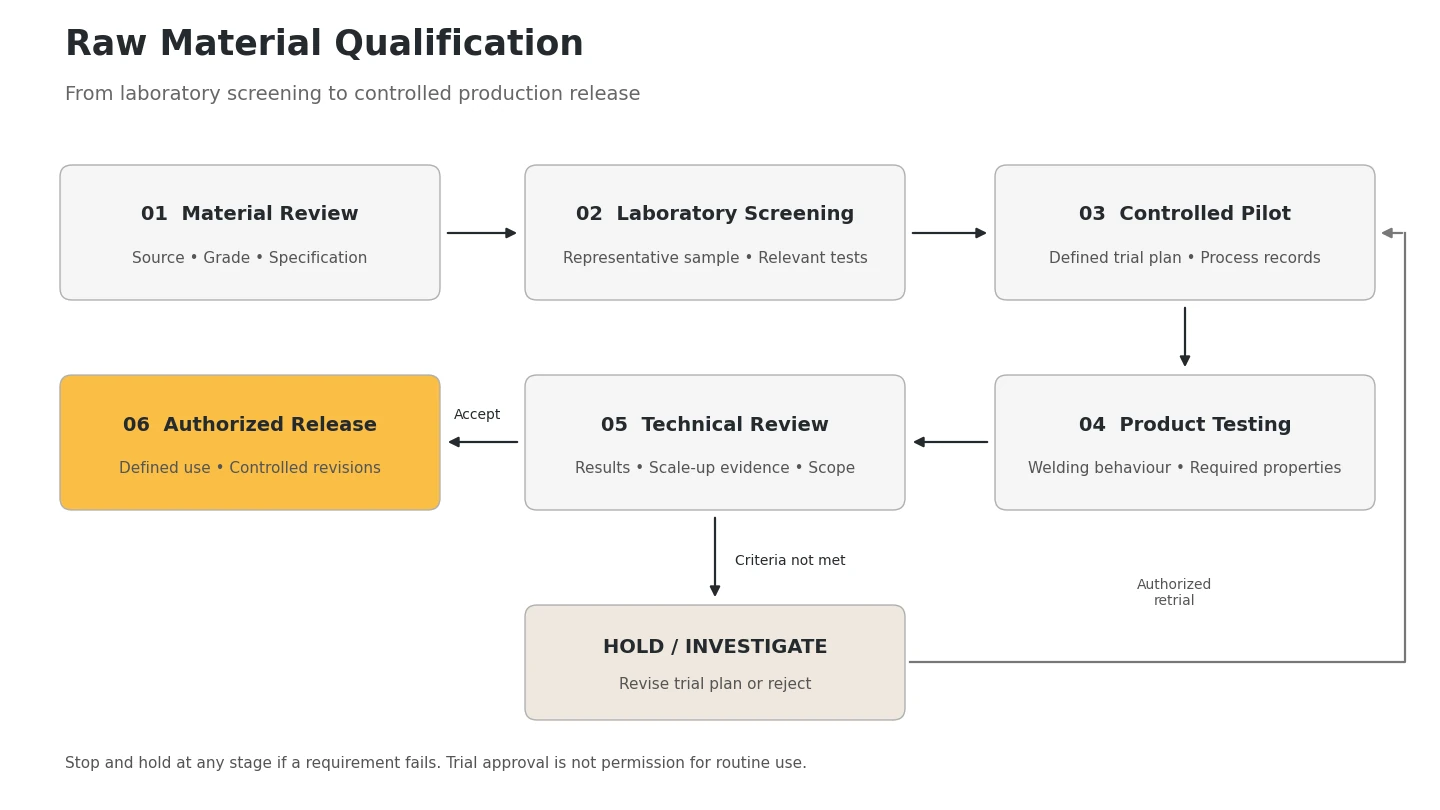
New raw material qualification connects laboratory results with actual manufacturing performance. Before a new supplier, material grade or formulation change enters routine production, a controlled pilot should show that the material can be processed consistently and that the finished welding consumable meets its intended requirements.
Explore the Quality Control Hub →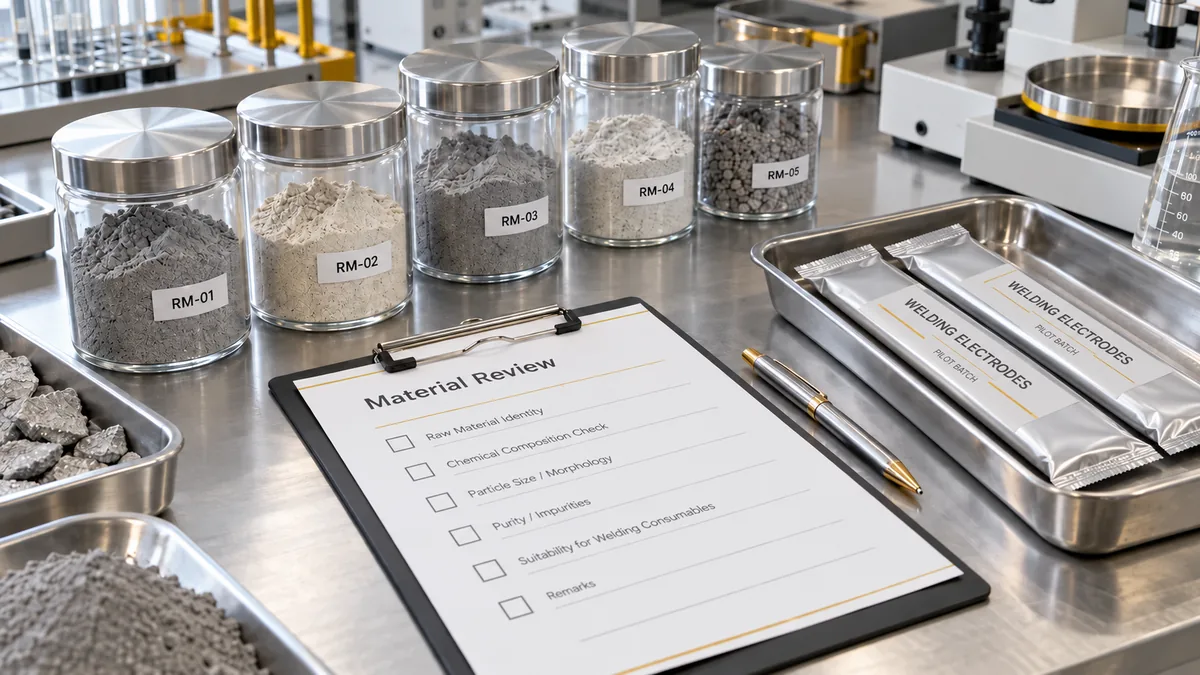
Why Laboratory Acceptance Is Only the First Step
A replacement mineral powder may satisfy the chemical specification yet behave differently during mixing or extrusion. A new steel strip may have acceptable chemistry but respond differently during forming and drawing. A silicate binder can meet its declared composition while requiring closer investigation of viscosity, solids content or interaction with the powder blend.
These possibilities make qualification a manufacturing decision as well as a laboratory task. The objective is to establish a documented link between a defined material source, an approved specification, a controlled process and acceptable product performance.
| Decision | Question It Answers | Typical Evidence |
|---|---|---|
| Supplier approval | Can this supplier consistently provide the required grade and supporting information? | Technical capability, traceability, change notification and delivery history |
| Material qualification | Is this defined material suitable for the intended products and process? | Laboratory assessment, pilot trials and product evaluation |
| Incoming lot acceptance | Does this delivery meet the approved purchasing specification? | Sampling, inspection, relevant testing and document review |
| Finished-product release | Can the manufactured batch be released for its stated application? | Completed production and test records reviewed by authorized personnel |
Approval of a supplier does not remove the need for incoming controls. Likewise, a successful pilot does not automatically release every future delivery or qualify the material for every formulation.
When Is a New Qualification or Change Review Needed?
Start a documented technical review when a change could affect manufacturing consistency or product performance. The review determines the extent of testing; every change does not necessarily require the same programme.
- A new manufacturer, manufacturing site or material grade is proposed.
- A mineral source, beneficiation route, milling process or surface treatment changes.
- Chemistry, impurity profile, particle size, moisture or other relevant properties move outside the qualified range.
- A wire rod or strip supplier changes, or a metallic feedstock's mechanical condition changes.
- A silicate binder grade or organic ingredient is replaced.
- A formulation is revised to improve performance, reduce cost or address supply limitations.
- Repeated production problems suggest that an already approved material needs reassessment.
Prioritize changes with greater consequences: materials used in hydrogen-controlled products, ingredients affecting weld metal chemistry, and feedstocks that influence critical forming or coating operations. Cost savings or delivery urgency should not bypass the technical release decision.
Review the Material Before Authorizing a Trial
Obtain the supplier's technical data, lot-specific certificate where available, safety information and the identity of the actual manufacturer. Compare the proposed grade with the current approved specification rather than relying only on a trade name.
Define the tests required by the ingredient's function. Chemical analysis, particle size and moisture may be relevant for powders; binder assessment may also include solids, density, viscosity and composition ratio under specified measurement conditions. Metallic feedstocks may require dimensional, surface and mechanical checks in addition to chemistry.
Use representative samples and a retained sample when required by the qualification plan. Confirm that the laboratory methods are suitable for the material and that equipment checks are current. Unexpected results should be investigated before the trial proceeds.
The supporting guides cover incoming raw material control, sampling and sample preparation, chemical analysis and particle size distribution control.
Build the Pilot Plan Before Making the Batch
A useful pilot answers a specific question. Identify the candidate material, the reference material and the products affected. Set acceptance criteria before examining the trial results so that the decision is not adjusted simply to accommodate an unsuccessful batch.
- Define the scope: product code, formulation revision, material grade, supplier lot, equipment and intended approval range.
- Set the comparison: use the qualified material as a reference under comparable conditions. Where practical, produce a reference batch close to the candidate trial.
- Control the variables: keep other ingredients and process conditions consistent when isolating the effect of a replacement. If several changes are necessary, use a documented trial design that can distinguish their effects.
- Specify measurements: select manufacturing observations, product tests, sample locations and acceptance limits.
- Assign responsibilities: name who authorizes the trial, produces it, performs tests, reviews results and approves the outcome.
- Define stop and hold rules: identify conditions that require stopping the run, segregating output or seeking a technical decision.
How Large Should a Pilot Batch Be?
Use a staged approach: laboratory screening, a pilot that represents the relevant operations, and controlled production-scale confirmation where needed. Batch size must suit the equipment's working range and provide enough material for processing, sampling and required tests.
A very small mixer charge may not reproduce normal mixing; a short wire run may miss feeding instability; and a lightly loaded oven may behave differently from a production load. Define the scale-up evidence needed before granting routine approval. No single pilot quantity in kilograms is appropriate for every electrode, flux or wire line.
Repeat runs or additional supplier lots may be necessary where variability is a concern. Repeated measurements of one sample cannot demonstrate consistency between manufacturing batches or supplier lots.
What to Observe During Pilot Production
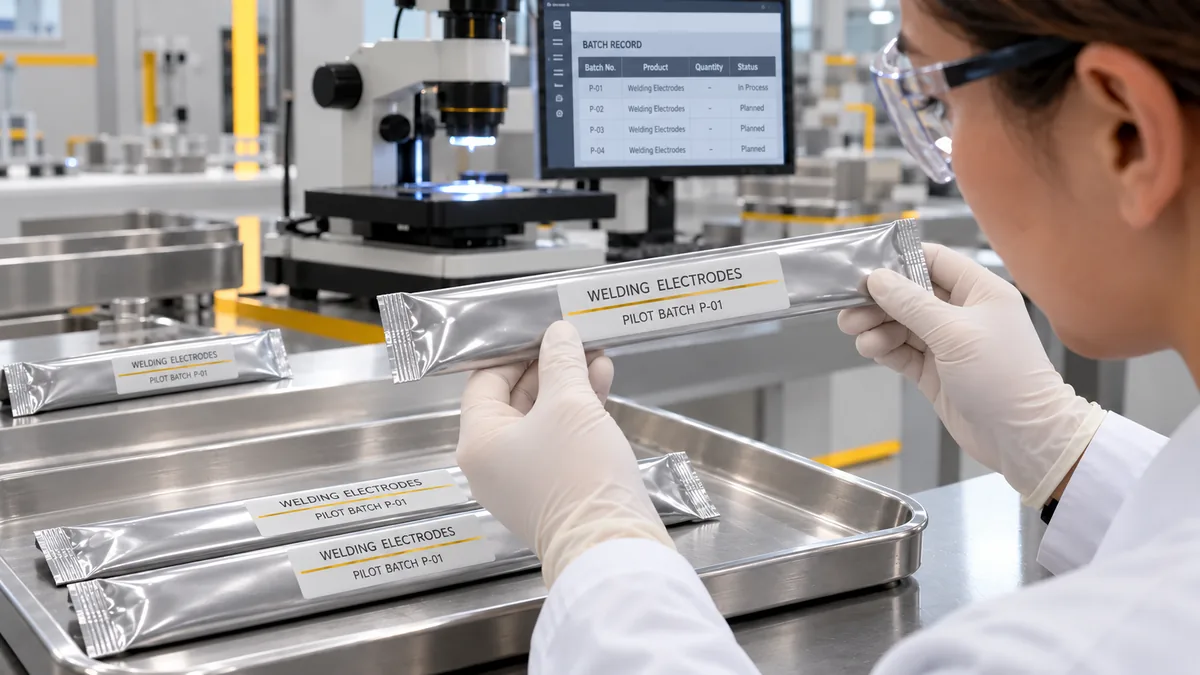
Record the actual settings and observations, including adjustments made by operators. A candidate that only works after substantial process changes has not demonstrated direct interchangeability with the existing material.
| Product Family | Manufacturing Checks | Evidence to Retain |
|---|---|---|
| Covered electrodes — SMAW | Dry blending, binder addition, paste consistency, extrusion behaviour, coating concentricity, surface condition, drying and baking response | Batch quantities, settings, defects, coating measurements, yield and samples taken after the defined conditioning cycle |
| Agglomerated SAW flux | Mixing, binder interaction, granulation, drying/baking, granule integrity and screening yield | Process records, grain-size fractions, fines generation and samples linked to the pilot lot |
| Fused SAW flux | Charging consistency, melting operation, cooling, crushing and screening under the qualified process | Production conditions, final chemistry, grain-size distribution and recovery/yield |
| Flux-cored wire — FCAW | Powder feeding, filling consistency, strip forming, seam condition, drawing behaviour and final wire dimensions | Defined fill-ratio measurements, process interruptions, dimensional checks and traceability of both strip and powder lots |
| Solid welding wire | Drawing response, surface condition, coating where applicable, diameter, ovality, cast, helix and spooling | Heat identity, processing records, dimensional results and feeding evaluation |
Choose checks for the actual product and production route. Record fill ratio on a clearly defined basis; a mass-based powder fraction is not the same as the powder's fraction of cross-sectional area. Numerical limits should come from the approved product and process specifications.
Evaluate Welding Behaviour and Finished-Product Properties
Manufacturing success is necessary, but it does not establish welding performance. Test the pilot output after the specified drying, baking, conditioning and storage sequence. Record those conditions so that results can be compared meaningfully.
Welding Performance
Assess the characteristics relevant to the product: starting and restarting, arc stability, feeding, slag removal, bead appearance, spatter, porosity and performance in the intended positions. Use defined equipment, polarity, parameters and shielding conditions. For SAW, identify the wire–flux combination; a flux result cannot automatically be transferred to every wire.
Product Verification
Select tests from the applicable consumable classification, customer requirements and the effects expected from the change. These may include weld metal chemistry, tensile properties, elongation, impact toughness, soundness and diffusible hydrogen where relevant. Hardness or wear testing may be appropriate for specific products, but is not a universal requirement.
Prepare test assemblies and specimens using the applicable methods. Record consumable diameter, welding parameters, preheat/interpass conditions, shielding gas or companion wire, and any heat treatment. An unrecorded change in test conditions can obscure the effect of the raw material.
For relevant steel, nickel and nickel-alloy all-weld-metal testing, ISO 15792-1 addresses test-piece and specimen preparation. It is not the procedure for every fillet or single-/two-run test. ISO 3690 addresses diffusible hydrogen determination within its specified scope. Use the full applicable requirements and a competent laboratory.
Make the Approval Decision Explicit
Review laboratory data, production observations and finished-product results together. Compare both specification compliance and the behaviour of the reference material. Include abnormal events, failed trials and any process adjustments in the review.
| Outcome | Required Action |
|---|---|
| Approved for defined use | State the accepted supplier/source, grade, specification revision, product range and process conditions. |
| Approved with restrictions | Document the allowed products, quantity or duration, additional checks and review date. Identify any required concessions separately. |
| Further development required | Keep the material on hold, identify the unresolved issue and authorize a new trial plan. |
| Rejected | Prevent unintended use and document return, alternative disposition or disposal under the quality procedure. |
Control Documents and the First Production Runs
Update the approved material specification, purchasing description, supplier status and incoming inspection plan. If the formulation or process changes, issue controlled revisions with an effective date and withdraw obsolete production copies.
Link the supplier lot to the pilot batch, test samples, laboratory reports and subsequent production batches. Record who approved the change and its scope. Set retention periods according to the quality system, contracts and applicable requirements rather than copying another plant's archive periods.
Use enhanced monitoring for initial routine runs when warranted. Review yield, defects, process adjustments and test results against the qualification evidence. Define when the material can move to normal inspection and what would trigger reassessment.
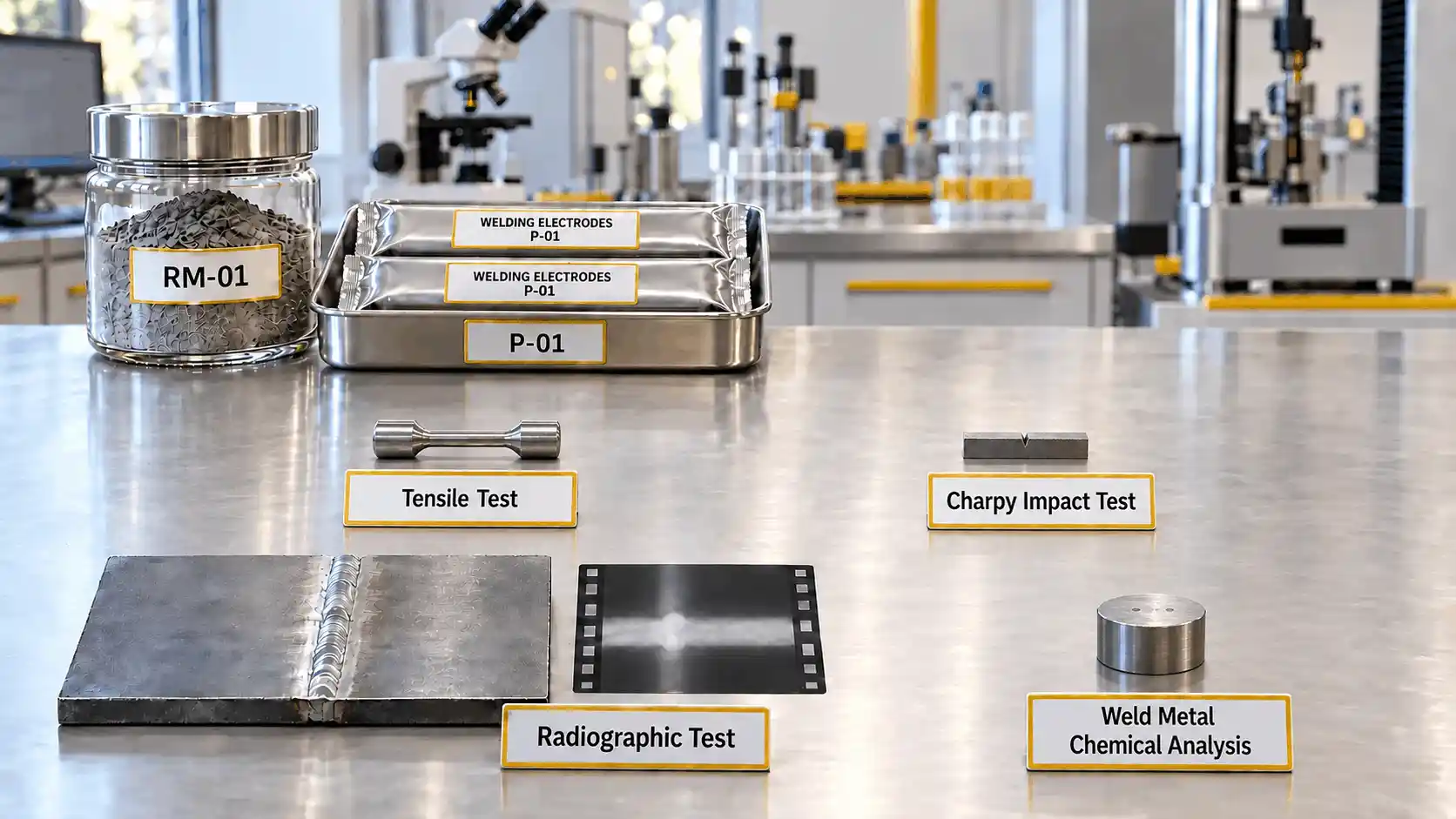
Example: Qualifying a Replacement Rutile Grade
Suppose an electrode manufacturer proposes a new rutile source. Its declared titanium dioxide content looks similar to the current grade. That comparison alone is insufficient: the evaluation should consider the relevant impurity profile, particle size, moisture and other characteristics identified by the formulation team.
After laboratory review, a controlled trial compares the candidate with the approved material. The team records paste behaviour, binder addition, extrusion, coating quality and the conditioning cycle, then performs the defined welding and product tests.
If satisfactory performance requires an adjusted binder addition or revised processing conditions, those changes become part of the qualification package. Approval should identify the applicable electrode codes and formulation revision. It should not simply state “new rutile approved for all production.”
This is an illustrative decision process, not a replacement formulation or a universal acceptance specification.
Frequently Asked Questions
Does every delivery need a full pilot trial?
No. Routine deliveries of an already qualified material follow the approved incoming inspection plan. A significant change, unexpected result or recurring production problem may trigger a new qualification review.
Is a supplier certificate enough to approve a new material?
A certificate supports the review but does not establish suitability for your formulation and process. Define the independent checks and production evidence needed for the intended use.
Can one successful pilot establish long-term consistency?
It demonstrates performance under the tested conditions. Additional runs or lots may be needed to assess variability and confirm production-scale performance.
Can an out-of-specification material be used in a trial?
An authorized, segregated development trial may be justified. Routine use requires a documented disposition, and any revised specification or formulation must be technically approved. Product and contractual requirements still apply.
Who should authorize routine use?
The person or team with defined technical and quality authority should review the complete evidence and approve the scope of use. Laboratory testing, purchasing and production each contribute information; none should silently substitute for the release process.
Standards and Further Reading
The following references support finished-consumable procurement and testing. They do not provide a universal recipe for qualifying mineral powders, binder replacements or pilot batch sizes. Select the product classification and requirements applicable to the intended consumable.
- ISO 14344:2024 — welding-consumable procurement, including classification, lot classification and testing schedules.
- AWS A5 filler-metal standards and AWS A5.01M/A5.01 — product specifications and procurement requirements. Use the applicable contractual edition.
- ISO 544:2024 — technical delivery conditions for filler materials and fluxes.
- ISO 15792-1:2020 — preparation of all-weld-metal test pieces and specimens within its scope.
- ISO 3690:2018 — determination of diffusible hydrogen within its specified scope.