
Introduction
The global wire drawing dies industry is entering a period of steady growth as manufacturers demand higher productivity, tighter dimensional tolerances, improved wire surface quality, and longer tooling life.
According to the Wire Drawing Dies – Global Market Share and Ranking, Overall Sales and Demand Forecast 2026–2032 report, published on August 5, 2026, the global wire drawing dies market was estimated at approximately US$710 million in 2025 and is expected to reach approximately US$745 million in 2026. The market is forecast to expand to approximately US$1.022 billion by 2032, representing a compound annual growth rate of about 5.4%.
This growth is being driven not simply by greater wire production, but by a transition toward increasingly demanding wire products used in electric vehicles, electrical grids, electronics, telecommunications, renewable energy, industrial manufacturing, welding consumables and other precision applications.
Global Market Outlook
| Year | Approximate Market Size |
|---|---|
| 2025 | US$710 million |
| 2026 | US$745 million |
| 2027* | US$785 million |
| 2028* | US$828 million |
| 2029* | US$872 million |
| 2030* | US$919 million |
| 2031* | US$969 million |
| 2032 | US$1.022 billion |
What Are Wire Drawing Dies?
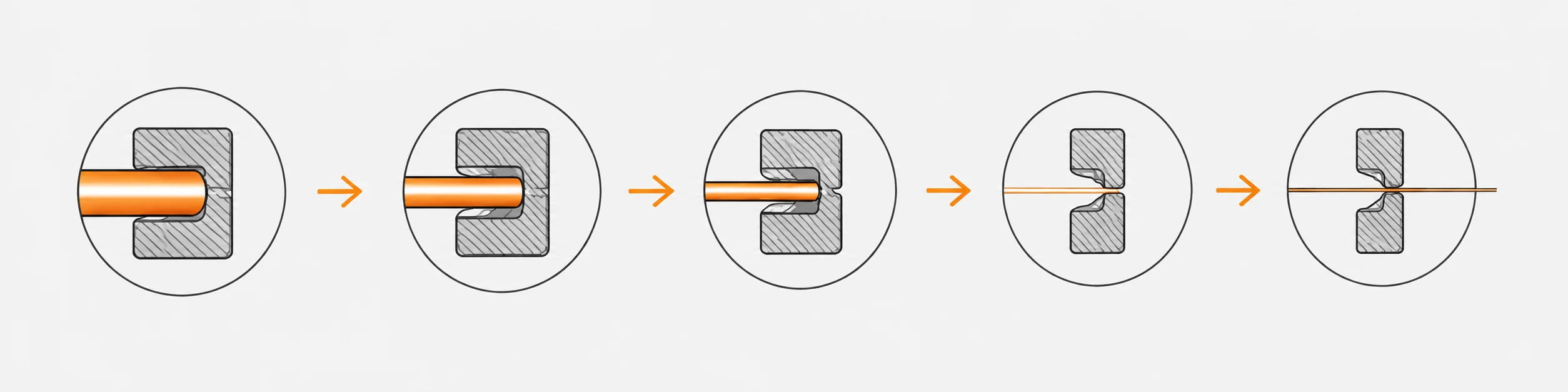
Wire drawing is a cold-forming process in which metal wire or rod is pulled through progressively smaller die openings. Each pass reduces the cross-sectional area while increasing wire length and modifying characteristics such as dimensional accuracy, surface condition and mechanical properties.
The drawing die is therefore much more than a simple wear component. Its geometry, surface finish, material, alignment and interaction with the lubricant directly influence drawing force, wire temperature, dimensional stability, production speed, surface quality and die life.
Applications include low-, medium- and high-carbon steel, alloy steel, stainless steel, welding wire, copper, aluminium and numerous specialty alloys.
Modern wire drawing lines can also contain very large die sets; Esteves notes that multi-wire drawing machines may use systems containing more than 450 dies.
This means that even relatively small improvements in die life or drawing stability can have significant consequences for plant productivity.
Market Segmentation by Die Type
The 2026 market report divides products into three principal categories:
- Diamond Wire Drawing Dies
- Carbide Wire Drawing Dies
- Other Drawing Dies
The 2026 market report estimates that diamond wire drawing dies account for approximately 72% of the global market, illustrating the increasing economic importance of high-performance tooling.
1. Diamond Wire Drawing Dies
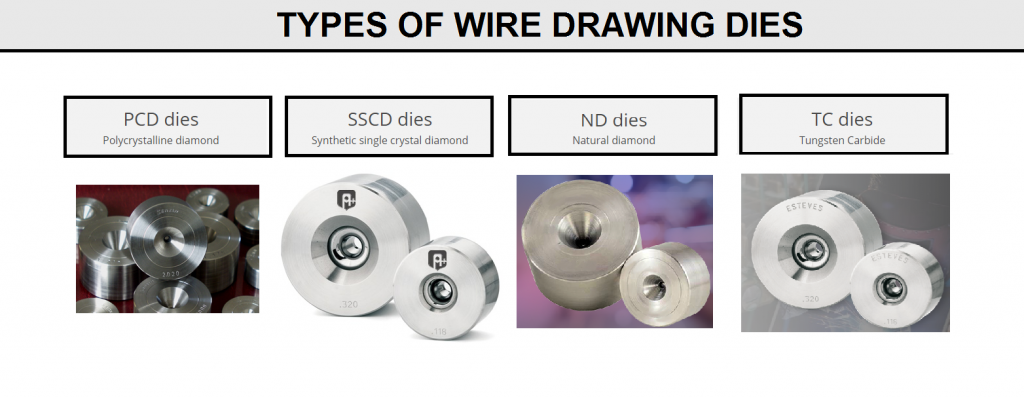
The term “diamond die” actually covers several technologies rather than one homogeneous product.
They include:
Natural Diamond (ND)
Traditionally used for extremely fine wire and applications requiring exceptional surface quality.
Synthetic Single-Crystal Diamond (SSCD)
Offers highly controlled material properties and is particularly attractive for ultra-fine precision applications.
Polycrystalline Diamond (PCD)
Produced from sintered diamond grains and widely used where long tooling life, dimensional stability and high-volume production are important.
Diamond-Coated Dies
A developing category in which diamond technology is combined with another supporting substrate to achieve better wear performance, especially in demanding steel-wire applications.
Asahi Diamond, for example, manufactures dies using natural diamond, synthetic single-crystal material and its SUNPAX diamond material for applications that include very fine wires used in semiconductor-related manufacturing.
Esteves likewise offers PCD, single-crystal diamond, natural diamond, tungsten carbide and diamond-coated systems. Its PCD products are designed for applications ranging from rod-size material to fine wire.
Why Diamond Dies Are Gaining Market Share
The main advantage is lifecycle economics.
Diamond dies normally carry a substantially higher purchase price than conventional tungsten carbide dies, but they can offer:
- longer production campaigns,
- fewer die changes,
- improved diameter consistency,
- better surface finish,
- less production interruption,
- lower scrap generation,
- greater dimensional stability at high drawing speeds.
An indicative comparison published by Esteves illustrates the magnitude of the difference. Depending heavily on material and operating conditions, the company reports PCD durability ranging from approximately 8–70 times tungsten carbide for ferrous materials and 50–500 times for non-ferrous materials. The manufacturer specifically cautions that actual performance depends on the wire, lubrication, drawing conditions and die geometry.
becomes
“Which die produces the lowest tooling cost per tonne of acceptable wire?”
That change in procurement philosophy should continue supporting premium die technologies through 2032.
2. Carbide Wire Drawing Dies
Tungsten carbide remains the workhorse of many industrial wire drawing operations.
It combines:
- high compressive strength,
- excellent abrasion resistance,
- comparatively low tooling cost,
- good resistance to severe drawing conditions,
- availability over large diameter ranges.
Carbide dies remain particularly important for coarser wire, steel-wire operations and production environments where the economics do not justify diamond at every drawing stage.
Commercial suppliers specifically list applications including:
- low-carbon steel,
- medium- and high-carbon steel,
- stainless steel,
- spring wire,
- steel cord,
- bead wire,
- welding wire,
- alloy steel,
- and various non-ferrous wires.
Paramount Die likewise supplies replaceable tungsten-carbide drawing inserts alongside PCD drawing dies and pressure-die systems.
This suggests that carbide is unlikely to disappear as diamond adoption increases. Instead, more sophisticated drawing plants will increasingly optimize the die sequence, using different die materials at different stages according to reduction, speed, wire material and economic requirements.
3. Other and Emerging Die Technologies
The “Others” category is smaller but technologically significant.
It can include ceramic systems, specialized tool materials, coated dies and hybrid solutions.
One particularly interesting development is the use of diamond coatings on dies intended for steel drawing. Esteves, for example, markets diamond-coated dies for steel as a bridge between traditional carbide tooling and conventional PCD solutions.
The longer-term direction is therefore likely to be less about choosing simply between “carbide or diamond” and more about engineering the optimum combination of:
Market Segmentation by Application
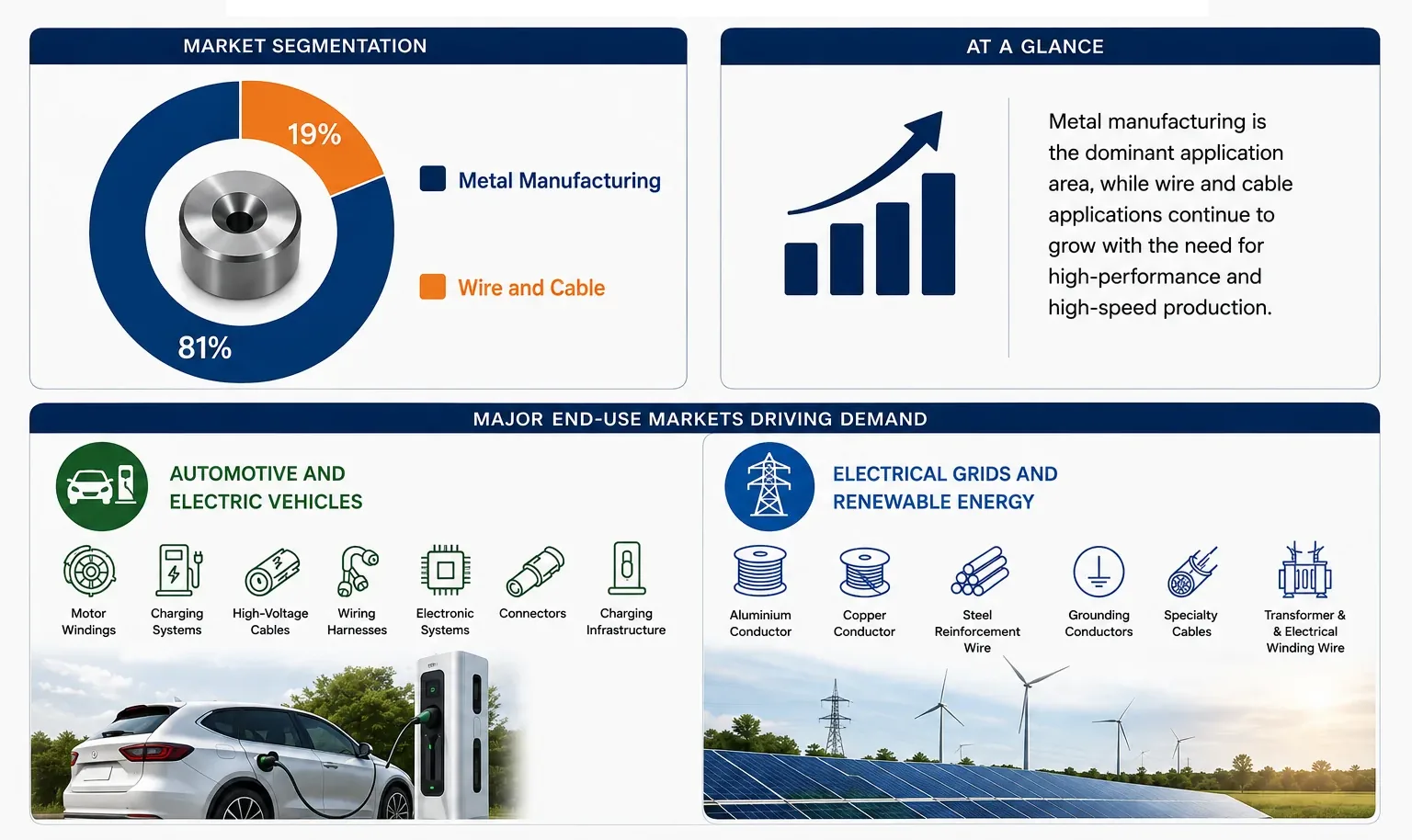
The market is divided principally into:
- Metal Manufacturing
- Wire and Cable
Metal manufacturing currently represents approximately 81% of the market, according to the 2026 report.
This broad segment includes production of copper, aluminium, stainless steel and numerous ferrous and specialty alloy wires.
The remaining market includes wire-and-cable-related applications in which dimensional control, surface quality and high-speed manufacturing are particularly important.
Major End-Use Markets Driving Demand
Automotive and Electric Vehicles
Vehicle electrification represents one of the strongest structural demand drivers for precision wire manufacturing.
EVs require substantial quantities of electrical conductors in applications such as:
- motor windings,
- charging systems,
- high-voltage cables,
- wiring harnesses,
- electronic systems,
- connectors,
- charging infrastructure.
The International Energy Agency expects global electric-car sales to reach approximately 23 million units in 2026, representing around 28% of total car sales worldwide.
Nearly 22 million electric cars were already manufactured globally during 2025.
Increasing conductor production consequently creates additional demand for reliable copper and aluminium drawing technology.
Electrical Grids and Renewable Energy
Grid expansion may ultimately prove just as important as vehicle electrification.
The IEA estimates that annual global grid investment needs to rise by approximately 50% from today's roughly US$400 billion level by 2030 to accommodate growing electricity demand.
Transmission and distribution expansion requires enormous quantities of:
- aluminium conductor,
- copper conductor,
- steel reinforcement wire,
- grounding conductors,
- specialty cables,
- transformer and electrical winding wire.
Every expansion in conductor manufacturing capacity creates corresponding demand for drawing machinery, dies, lubricants and die-maintenance systems.
AI Data Centres and Digital Infrastructure
Another less obvious driver is the rapid expansion of artificial intelligence infrastructure and data centres.
The IEA projects global data-centre electricity consumption to approximately double to around 945 TWh by 2030, with electricity demand from data centres growing around 15% annually from 2024 to 2030 in its base case.
The connection with drawing dies is indirect but significant.
More data centres require additional:
- power distribution equipment,
- transformers,
- copper conductors,
- switchgear,
- backup-power infrastructure,
- communication infrastructure,
- grid reinforcement.
Therefore, the AI boom is simultaneously becoming an electrical-infrastructure investment cycle—and that ultimately supports demand for wire and cable production.
Welding Wire: A Specialized Opportunity
Welding wire represents a technically important niche within the wider wire drawing industry.
The market definition explicitly includes welding wire among applications for wire drawing dies.
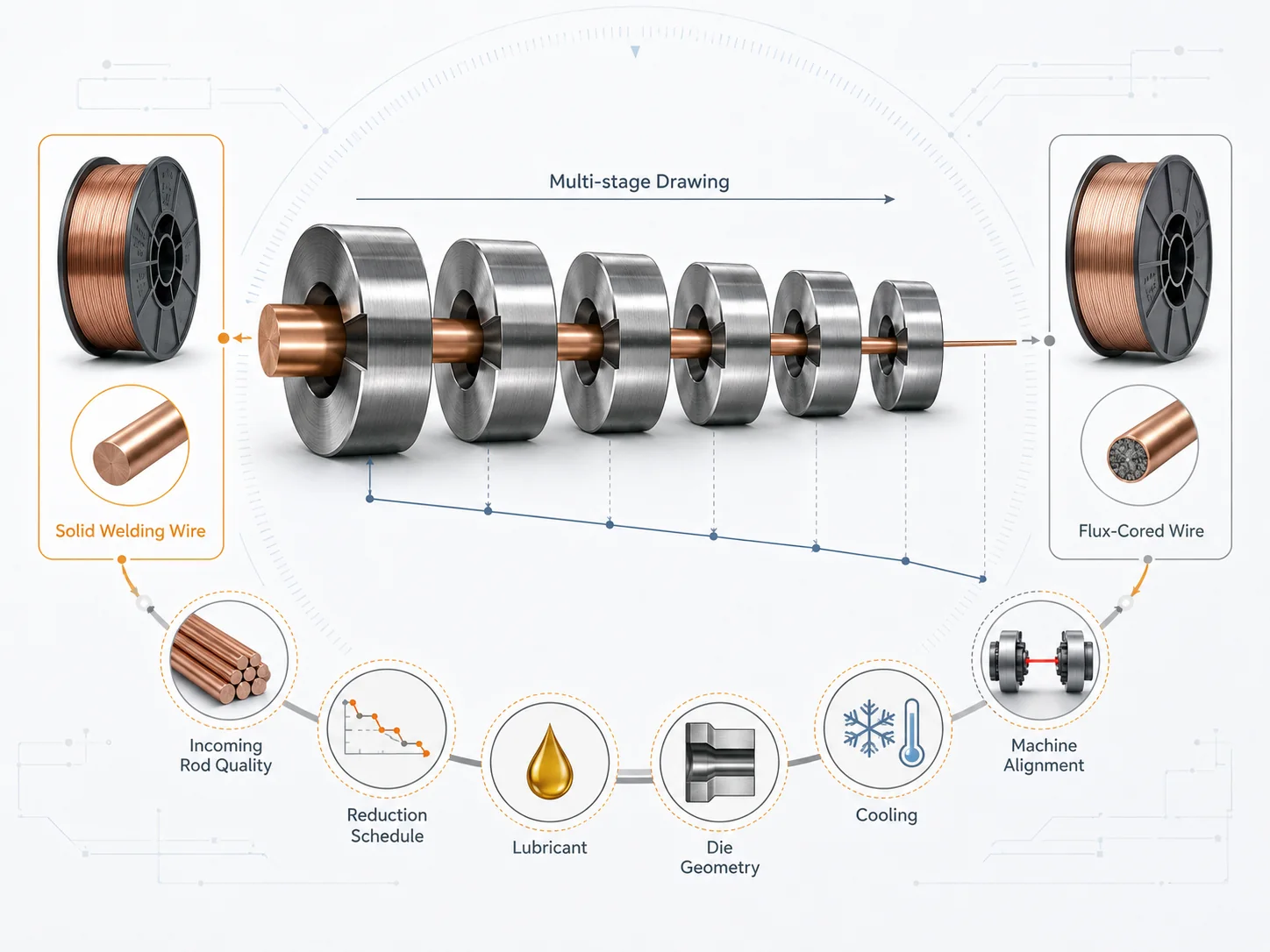
Solid welding wires such as GMAW/MAG products require controlled multi-stage reduction from rod to final diameter. Drawing stability affects final wire diameter, surface condition and production efficiency.
Die selection becomes particularly important as manufacturers attempt to increase drawing speed while controlling tooling consumption.
Wire drawing tooling is also relevant to some flux-cored-wire manufacturing technologies where the formed strip passes through reduction stages after filling and forming.
For welding-consumable manufacturers, therefore, die procurement should be treated as part of the overall process engineering system rather than as a stand-alone spare-part purchase.
Wire quality, incoming rod condition, reduction schedule, lubricant, die geometry, cooling and machine alignment must be optimized together.
Competitive Landscape in 2026
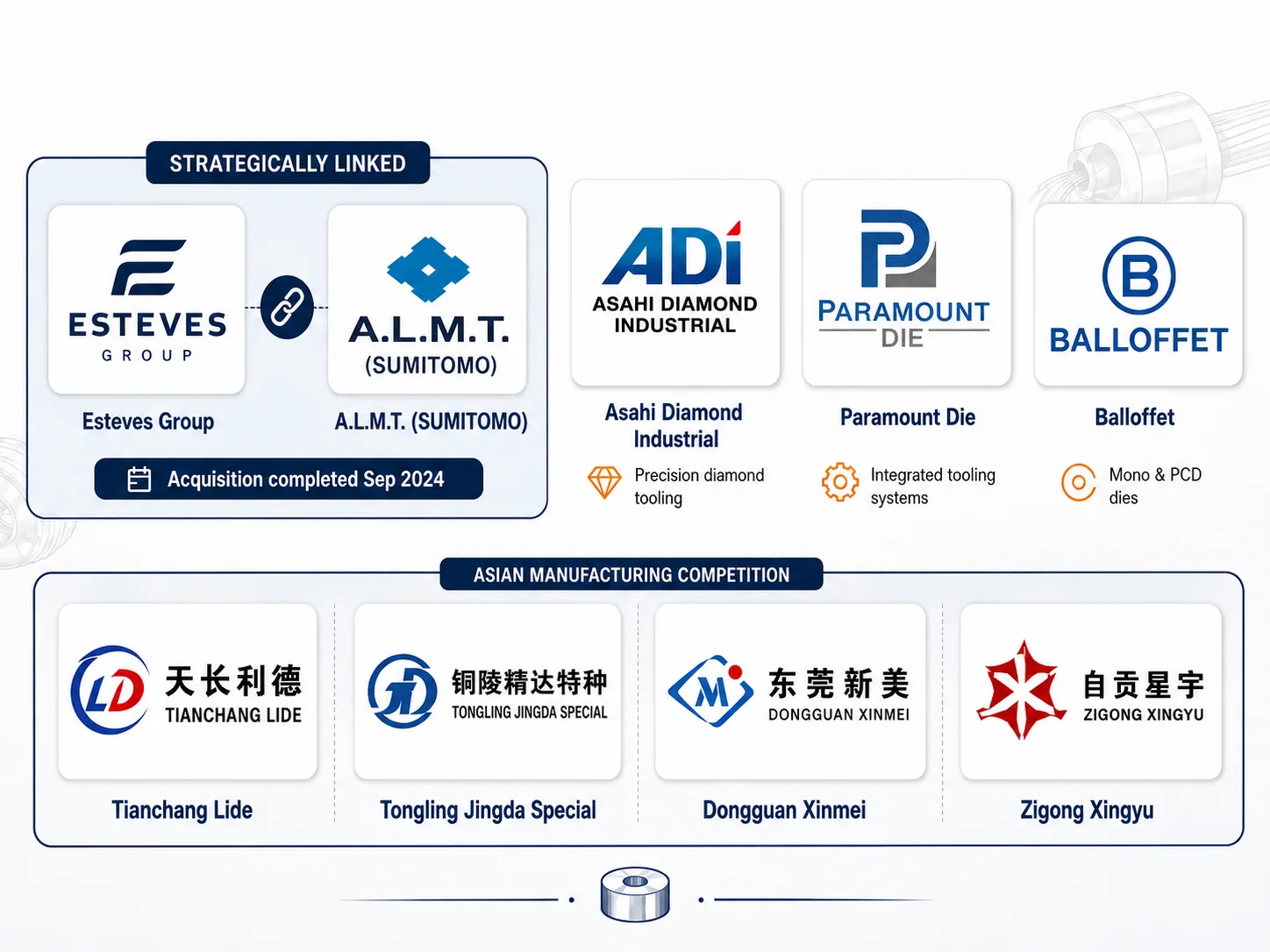
The 2026 market report identifies the following companies among major participants in the global market:
- Esteves Group
- A.L.M.T. (SUMITOMO)
- Asahi Diamond Industrial
- Paramount Die
- Tianchang Lide
- Isis SAS
- Tongling Jingda Special
- Dongguan Xinmei
- Zigong Xingyu
- Balloffet
However, there is an important structural change behind this list.
A.L.M.T. and Esteves Are No Longer Fully Independent Competitors
A.L.M.T., a wholly owned subsidiary of Sumitomo Electric, completed its acquisition of all shares of Esteves Group in September 2024.
Sumitomo Electric stated that the objective was to combine the companies' diamond-die product portfolios, technological capabilities, sales networks and service bases while maintaining the Esteves brand.
This is strategically important.
Esteves brings more than a century of wire-tooling history and facilities across Europe, North America and Asia, while A.L.M.T. contributes extensive capabilities in diamond and advanced industrial materials.
The combination potentially creates one of the strongest global technology and service networks in the drawing-die industry.
Asahi Diamond Industrial
Asahi Diamond competes strongly in precision diamond tooling.
Its portfolio includes natural diamond, synthetic single-crystal diamond and SUNPAX-based drawing dies, with products addressing extremely fine wire and semiconductor-related applications.
This positions the company particularly well as electronics and ultra-fine-wire requirements become more demanding.
Paramount Die
Paramount differentiates itself through a systems-oriented approach combining:
- tungsten-carbide drawing inserts,
- PCD drawing dies,
- die holders,
- pressure drawing systems,
- and associated tooling technologies.
Such integrated approaches reflect an important evolution in the market: customers increasingly want productivity solutions rather than individual dies.
Balloffet
Balloffet supplies both mono-crystalline and polycrystalline diamond dies across applications including copper and aluminium, stainless and alloy steel, fine and ultra-fine wire, shaped wire, enamelled wire, coated wire, tubes and compacting applications.
Its shaped-die capabilities also illustrate another growth area: wire producers increasingly require profiles beyond conventional round wire.
Asian Manufacturing Competition
The 2026 report also identifies Tianchang Lide, Tongling Jingda Special, Dongguan Xinmei and Zigong Xingyu among significant market participants.
This reflects the importance of Asian manufacturing to the global wire-industry supply chain.
An earlier market assessment valued the Asia-Pacific wire drawing dies market at approximately US$396.7 million out of a US$645.9 million global market in 2023, equivalent to roughly 61% of the total at that time. It projected Asia-Pacific to reach approximately US$593 million by 2030.
The public summary of the new 2026–2032 report does not disclose an updated regional percentage, so precise current regional shares should not be assumed without the complete dataset.
What Will Define Competition Through 2032?
The next phase of competition will increasingly revolve around total process performance rather than die price alone.
Several areas appear especially important.
1. Longer Die Life
Customers will increasingly evaluate dies on cost per tonne or kilometre of acceptable finished wire.
Reduced downtime and fewer die changes may justify significantly higher initial tooling prices.
2. Ultra-Fine Wire Capability
Electronics, medical devices, advanced sensors and other precision applications require increasingly small diameters and tighter tolerances.
Diamond technologies are particularly well positioned for this trend. The market report specifically associates diamond dies with fine and ultra-fine wire applications in electronics and medical technology.
3. Better Surface Quality
Future competition will involve not merely achieving the correct diameter but controlling:
- surface roughness,
- scratching,
- coating integrity,
- roundness,
- dimensional variation,
- and drawing-induced defects.
This becomes increasingly important for plated, coated, enamelled and high-value specialty wires.
4. Customized Die Geometry
A die cannot be optimized independently of the drawing process.
Approach angle, bearing geometry and lubrication conditions all affect deformation and finished-wire performance. Paramount, for example, describes the approach area as the critical region where area reduction and lubricant compaction occur, while the bearing controls final diameter, roundness, straightness and surface finish.
Accordingly, customized die profiles matched to wire chemistry, reduction schedule and machine conditions should become a stronger competitive differentiator.
5. Hybrid and Coated Tooling
The industry is moving beyond the simple carbide-versus-diamond comparison.
Diamond coatings, engineered PCD structures, specialty grain sizes and hybrid material systems create opportunities to optimize performance for specific applications.
The 2026 report identifies synthetic diamond, nanostructured materials, coatings and hybrid material development among the technologies expected to influence market growth.
6. Die Reconditioning and Lifecycle Services
High-value diamond tooling also creates a growing service market.
Instead of treating dies as disposable production consumables, manufacturers can develop systematic inspection, polishing, recutting and inventory-management programs.
toward
tooling technology partner → manufacturing process
Market Challenges
Higher Initial Cost
Diamond and advanced dies can require substantially more capital than carbide tooling. Their economic advantage depends on utilization rate, wire material and achieved die life.
Process Sensitivity
An expensive die cannot compensate for poor wire preparation, inadequate lubrication, excessive reduction, poor cooling or machine misalignment.
Competitive Pricing Pressure
Standard carbide and lower-complexity die categories face growing competition from regional manufacturers, particularly in highly industrialized Asian supply chains.
International Trade and Supply-Chain Risk
The 2026 market report specifically identifies tariffs and changes in international supply chains as factors that could alter regional competition and sourcing strategies.
Increasing Customer Expectations
Wire manufacturers increasingly expect tooling suppliers to support process optimization, troubleshooting, die-life analysis and customized design rather than simply manufacture a component.
Where Are the Best Opportunities Through 2032?
Several areas appear especially attractive.
High-performance PCD and synthetic-diamond dies should continue gaining importance wherever production volume and quality justify their higher acquisition cost.
Copper and aluminium conductor manufacturing will benefit from expansion in EVs, charging infrastructure, renewable energy and electrical grids.
Fine and ultra-fine wire offers attractive value-added opportunities in electronics, semiconductors and medical applications.
Advanced steel-wire tooling remains significant for automotive components, tire reinforcement, spring wire, fasteners, welding wire and industrial products.
Die-management and reconditioning services offer recurring revenue and stronger relationships with manufacturers.
Application-specific engineering may ultimately become one of the most valuable capabilities of all. Suppliers able to optimize die material, geometry, reduction schedule, lubrication and maintenance as a complete system should have an advantage over commodity tooling producers.
Outlook to 2032
The global wire drawing dies market is relatively small compared with the enormous wire, cable, automotive and electrical industries it supports. Nevertheless, it occupies a strategically important position in those value chains.
The latest market forecast points to expansion from approximately US$745 million in 2026 to US$1.022 billion in 2032, equivalent to roughly 5.4% annual growth. Diamond dies already represent approximately 72% of the market, while metal-manufacturing applications account for approximately 81%.
But the more significant transformation may be qualitative rather than simply quantitative.
Wire manufacturers are demanding:
- higher speed,
- longer tooling life,
- tighter tolerances,
- superior surface quality,
- greater process stability.
Meanwhile, global electrification is increasing the strategic importance of wire itself. EV sales continue growing, electricity grids require significantly higher investment, renewable generation is expanding and data centres are placing unprecedented pressure on power infrastructure.
As a result, drawing dies are evolving from relatively conventional consumable tools into increasingly engineered components of high-productivity manufacturing systems.
Through 2032, the strongest market opportunities are therefore likely to belong not simply to companies capable of making harder dies, but to those capable of delivering the right die material, the right geometry and the right process solution for a specific wire manufacturing application.
That distinction will increasingly define the competitive landscape of the global wire drawing dies industry.

 Email:contact@wespec.net