
The welding electrode packing stage is the final production step before finished electrodes enter the warehouse and are delivered to customers. A properly designed packing system protects electrode quality, controls moisture exposure, ensures traceability, and creates a professional finished product.
A technically correct packing system must do more than place welding electrodes inside a box. It must protect the coating against physical damage, prevent unwanted moisture absorption or moisture loss, maintain the correct pack weight, identify the production batch and prepare the product for safe transportation.
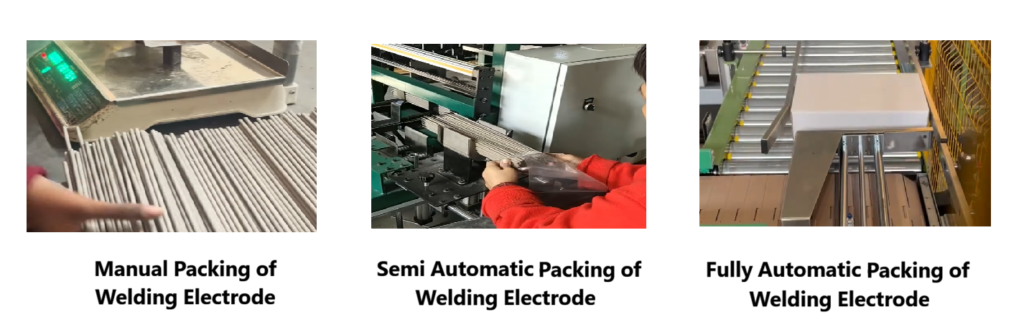
Depending on the production capacity, labour cost, electrode type and required packaging format, manufacturers can use a manual, semi-automatic or fully automatic welding electrode packing line.
This article explains each solution, its advantages and disadvantages, the main quality-control points and the factors that should be considered when selecting packing equipment.
The following table compares manual, semi-automatic, and fully automatic welding electrode packing systems based on investment, labour requirements, production output, flexibility, and suitable factory capacity.
| Packing method | Investment | Labour | Output | Flexibility | Best suited for |
| Manual | Low | High | Low | Very high | Small plants and special products |
| Semi-automatic | Medium | Medium | Medium | High | Medium-capacity factories |
| Fully automatic | High | Low | High | Medium | Large and standardized production |
- Why Is Packing Important in Welding Electrode Production?
- Packaging Requirements for Different Electrode Types
- Manual Welding Electrode Packing
- Semi-Automatic Welding Electrode Packing
- Fully Automatic Welding Electrode Packing Line
- How to Calculate the Required Packing-Line Capacity
- Common Mistakes in Welding Electrode Packing
- Recommended Suppliers for Automatic Welding Electrode Packing Lines
- How WESPEC Can Support Your Packing-Line Project
Why Is Packing Important in Welding Electrode Production?
Covered welding electrodes are vulnerable to both mechanical and environmental damage. The coating may crack, chip or separate from the core wire if electrodes are dropped, compressed or handled incorrectly.
Moisture is another critical factor. Different electrode coatings require different packaging strategies:
- Low-hydrogen basic electrodes must be protected against moisture absorption.
- Cellulosic electrodes must retain the moisture level required by their formulation.
- Rutile electrodes are generally less moisture-sensitive but still require protection against humidity, contamination and physical damage.
- Stainless steel, low-alloy, nickel-alloy and other special electrodes may require sealed or moisture-resistant packaging depending on their coating and hydrogen requirements.
The correct packaging system therefore supports:
- Protection against humidity and contamination
- Prevention of coating cracks and edge damage
- Accurate net weight or electrode count
- Batch and lot traceability
- Professional product presentation
- Easier storage and transportation
- Compliance with customer and market requirements
- Reduction of customer complaints and returned products
Packing must consequently be considered part of the product quality system rather than only an end-of-line operation.
Packaging Requirements for Different Electrode Types
Rutile Electrodes
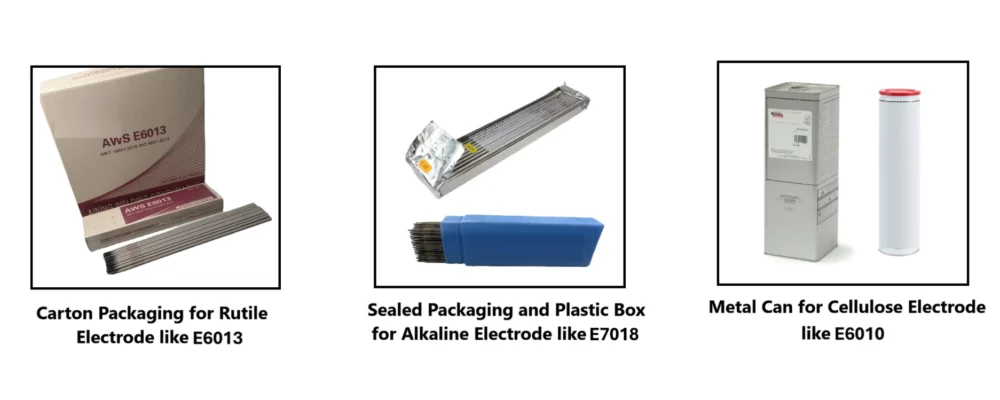
General-purpose rutile electrodes, such as many E6013 products, are commonly packed in printed cardboard boxes followed by polyethylene film, shrink wrapping or a master carton.
The main objectives are:
- Preventing coating damage
- Maintaining product cleanliness
- Providing moderate moisture protection
- Creating an attractive retail package
- Simplifying warehouse handling
A standard carton and shrink-wrapping system may be sufficient when the electrodes are intended for normal industrial storage conditions.
Basic Low-Hydrogen Electrodes
Basic electrodes such as E7018 require significantly better moisture protection.
Possible packaging formats include:
- Vacuum-sealed multilayer barrier packs
- Hermetically sealed metal cans
- Moisture-resistant composite containers
- Sealed plastic or aluminium-laminate packs inside cartons
The packaging line should minimize the exposure time between final baking and sealing. Seal integrity, vacuum condition and barrier-film quality must also be checked.
The objective is to preserve the low-moisture condition achieved during baking and reduce the need for re-drying before use.
Cellulosic Electrodes
Cellulosic coatings require a controlled amount of moisture for their characteristic welding behaviour. Packaging must prevent uncontrolled drying as well as excessive moisture absorption.
Sealed cans or other moisture-retaining packaging systems may be used depending on the product formulation and manufacturer’s technical instructions.
Cellulosic electrodes should not automatically be treated in the same manner as low-hydrogen basic electrodes. Their required coating moisture conditions are fundamentally different.
Stainless Steel and Special-Alloy Electrodes
Stainless steel, nickel-alloy, hardfacing and other special electrodes often have a higher product value. Their packaging should provide strong protection against physical damage, contamination and moisture.
Smaller pack sizes may also be commercially preferable because customers frequently consume these products in lower quantities.
Manual Welding Electrode Packing
In a manual packing system, operators perform most of the main activities, including inspection, alignment, weighing, box filling, sealing, labelling and master-carton preparation.
A basic manual packing station may contain:
- Stainless steel or coated worktables
- Electrode alignment trays
- Digital weighing scales
- Manual carton-forming fixtures
- Tape or hot-melt sealing tools
- Label printers
- Batch-code printers
- Small heat-sealing or shrink-wrapping machines
- Roller conveyors
- Manual pallet-wrapping tools
Advantages of Manual Packing
Manual packing offers several benefits:
- Low initial investment
- Simple installation
- Easy operation and maintenance
- High flexibility for different electrode sizes
- Fast changeover between products
- Suitable for small production volumes
- Suitable for special electrodes and small orders
- Easy expansion by adding additional workstations
Disadvantages of Manual Packing
The main limitations are:
- High dependence on operator performance
- Higher labour requirement
- Lower and less predictable output
- Greater risk of weighing and labelling errors
- Inconsistent package appearance
- More handling of the electrode coating
- Difficulty maintaining stable traceability
- Higher risk of production bottlenecks
- Reduced efficiency during large-volume orders
Manual packing is normally suitable for pilot plants, small factories, special-product lines or production facilities operating with low labour costs and many different products.
However, a manual system still requires written work instructions, calibrated scales, approved packaging materials and recorded quality checks.
Semi-Automatic Welding Electrode Packing
A semi-automatic system combines operator handling with selected automatic operations.
For example, operators may load electrodes into a feeder or alignment tray while machines perform counting, weighing, carton closing, film wrapping, printing or checkweighing.
A typical semi-automatic arrangement may include:
- Manual electrode inspection and loading
- Automatic alignment or counting
- Automatic or assisted weighing
- Manual placement into the inner box
- Automatic box closing
- Automatic shrink wrapping or heat sealing
- Automatic label application
- Manual master-carton packing and palletizing
Different combinations can be used according to the factory’s priorities.
Advantages of Semi-Automatic Packing
- Lower investment than a fully automatic line
- Higher output than manual packing
- Better weight consistency
- Reduced operator fatigue
- Improved package appearance
- Easier batch-code and label control
- Flexible configuration
- Possibility of future expansion
- Suitable for medium production capacities
- Faster product changeover than some full automatic systems
Disadvantages of Semi-Automatic Packing
- Operators are still required at important points
- Output depends partly on manual loading speed
- Poor line balancing can create waiting time
- Traceability may not be completely automatic
- Product handling remains higher than in a fully automatic system
- Several separate machines may require manual transfer
- Future integration can be difficult if equipment is purchased without a complete plan
For many medium-sized welding electrode factories, a semi-automatic solution provides the best balance between investment, production capacity and flexibility.
Fully Automatic Welding Electrode Packing Line
A fully automatic welding electrode packing line connects the main packaging stages into one coordinated system.
Depending on the design, the line may perform:
- Automatic electrode de-racking or furnace discharge
- Automatic feeding and alignment
- Visual or sensor-based inspection
- Counting and weighing
- Automatic carton forming
- Electrode loading
- Checkweighing
- Carton closing and hot-melt sealing
- Batch-code and label printing
- Film wrapping, vacuumizing or heat sealing
- Rejecting incorrect packages
- Multipack or master-carton formation
- Robotic palletizing
- Automatic stretch wrapping
- Pallet labelling and warehouse transfer
A central programmable logic controller can control the line and record operating information. Advanced systems may also connect to enterprise resource planning or manufacturing execution software for batch traceability.
Advantages of Fully Automatic Packing
- High and stable production capacity
- Lower direct labour requirement
- Consistent pack weight and appearance
- Reduced manual contact with electrodes
- Better label and batch traceability
- Automatic rejection of incorrect packages
- Easier production-data collection
- Improved workplace ergonomics
- Suitable for continuous high-volume production
- Better integration with automatic warehouses and pallet systems
Disadvantages of Fully Automatic Packing
- High initial investment
- Greater maintenance requirements
- Need for trained electrical and mechanical technicians
- Longer installation and commissioning period
- More complicated product changeovers
- Dependence on spare parts and supplier support
- Risk of stopping the entire line because of one machine fault
- Requirement for consistent upstream production
- More factory space and utility connections
- Possible difficulty handling unusual electrode sizes or small orders
A fully automatic line is most suitable when the plant has high and stable output, standardized package formats and sufficient technical personnel to maintain the equipment.
Full automation should not be selected only to reduce the number of operators. Its economic justification should be based on total production volume, labour cost, rejected packages, downtime, maintenance cost, traceability requirements and expected return on investment.
How to Calculate the Required Packing-Line Capacity
The capacity of the packing line must be matched to the real output of the baking or production line.
A simple initial calculation is:
Required packages per hour = Electrode output in kg per hour ÷ Net weight of each package
For example, consider a plant producing 5 tons during one eight-hour shift:
- Daily output: 5,000 kg
- Hourly average: 625 kg
- Inner-box weight: 5 kg
- Required average output: 125 boxes per hour
The selected line should not be limited to exactly 125 boxes per hour. A reasonable capacity margin should be included for temporary production peaks, stoppages, cleaning and changeovers.
With a 20% margin, the target becomes approximately:
125 × 1.20 = 150 boxes per hour
This is only an initial capacity calculation. The final selection must also consider:
- Number of electrode diameters
- Electrode lengths
- Different box weights
- Number of product classifications
- Shift arrangement
- Furnace discharge method
- Planned production growth
- Actual equipment efficiency
- Changeover and cleaning time
- Required moisture-protection system
Common Mistakes in Welding Electrode Packing
Several mistakes can reduce packaging quality even when good machines are installed.
Selecting Equipment Only by Maximum Speed
The highest advertised speed is not necessarily the real production speed. The supplier should demonstrate the line using the customer’s actual electrode diameter, length, box and packaging film.
Ignoring Product Changeover
A machine may operate efficiently with one 3.2 mm electrode and one box size but require excessive adjustment for other diameters and lengths.
The required change parts, adjustment time and recipe storage should be evaluated before purchase.
Using Inadequate Moisture Barriers
A visually attractive cardboard box does not necessarily protect low-hydrogen electrodes. Barrier-film properties, sealing quality and package integrity are more important than appearance.
Inadequate Line Balancing
The counting machine, carton former, wrapping machine and palletizing unit must operate at compatible capacities. One undersized machine can limit the entire line.
Purchasing Separate Machines Without Integration
Buying low-cost individual machines from different suppliers can create communication, synchronization and safety problems. One party should be responsible for overall line integration.
Neglecting Spare Parts and Technical Support
The buyer should identify critical spare parts, expected delivery time, remote support, software access and technician availability before placing an order.
Failing to Perform a Proper FAT
A factory acceptance test should use the buyer’s actual electrodes and packaging materials whenever possible.
The FAT should confirm:
- Required production capacity
- Weight accuracy
- Counting accuracy
- Changeover time
- Seal quality
- Label accuracy
- Reject-system operation
- Safety interlocks
- Alarm functions
- Pallet pattern
- Final package appearance
Recommended Suppliers for Automatic Welding Electrode Packing Lines
The following companies can be considered when preparing a technical and commercial supplier comparison. This is not a universal ranking. The best supplier depends on the required capacity, package format, automation level, budget and local service requirements.
Imanpack – Italy
Imanpack offers customized systems for counting, aligning, cartoning, flow wrapping, multipacking and robotic palletizing of welding electrodes.
Its solutions are suitable for manufacturers looking for a high-level turnkey line with integrated checkweighing, box forming, sealing, moisture-protection packaging and end-of-line automation.
Imanpack is a strong candidate for high-capacity factories that prioritize European engineering, customization and complete pack-to-pallet integration.
Starpac India – India
Starpac has developed complete welding electrode packaging automation involving high-speed counting, carton forming, filling, sealing, flow wrapping, optional vacuumizing, case packing and preparation for robotic palletizing.
Its modular approach can be suitable for manufacturers in India, the Middle East, Africa and Asia that require a customized automatic system with regional support.
Nantong ACE Welding – China
Nantong ACE offers both semi-automatic and fully automatic packing equipment for welding electrodes and welding wires.
It may be considered by manufacturers looking for a more economical solution or a supplier familiar with other welding-consumable production equipment. The buyer should carefully confirm performance, component brands, software documentation, after-sales service and reference installations.
WANERX – China
WANERX offers automatic welding electrode packaging machines, complete production-line solutions and robotic palletizing equipment.
Its product range may be suitable for projects requiring integrated carton handling, electrode packing and pallet automation. A detailed technical review should confirm whether the proposed equipment can handle all required electrode diameters, lengths and package formats.
VASPO VAMBERK – Czech Republic
VASPO VAMBERK supplies machinery and components for covered-electrode production, including packing machines, electrode conveyors, de-racking systems and identification equipment.
It can be considered for complete European production-line projects, modernization of existing factories or integration of the packing system with upstream electrode-manufacturing equipment.
| Supplier | Country | Automation level | Main strength | Suitable for |
| Imanpack | Italy | Full automatic | Complete pack-to-pallet integration | High-capacity projects |
| Starpac | India | Modular/full automatic | Regional support and customization | Asia, Middle East and Africa |
| Nantong ACE | China | Semi/full automatic | Economic complete solutions | Budget-sensitive projects |
| WANERX | China | Full automatic | Packing and palletizing integration | Integrated automation |
| VASPO VAMBERK | Czech Republic | Industrial/turnkey | Integration with electrode production | European projects and modernization |
How WESPEC Can Support Your Packing-Line Project
WESPEC provides independent technical consulting for the design, selection and implementation of welding electrode production equipment.
Our services for the packing stage can include:
- Determining the appropriate automation level
- Calculating the required packing capacity
- Preparing the technical RFQ
- Comparing supplier proposals
- Reviewing equipment layouts
- Evaluating packaging formats
- Reviewing moisture-protection requirements
- Inspecting equipment during manufacturing
- Performing or supervising FAT and SAT
- Supporting installation and commissioning
- Preparing packing and quality-control instructions
- Training production and maintenance personnel
WESPEC is a consulting and engineering team, not a packing-machine seller. This allows us to compare suppliers independently and recommend a solution based on the manufacturer’s actual production target, technical requirements and investment budget.
For a wider explanation of the complete production process, read our articles about the welding electrode manufacturing process Welding Electrode Manufacturing Process, the welding electrode production line, and Welding Electrode Production Cost.
Contact WESPEC to design or improve a manual, semi-automatic or fully automatic welding electrode packing system.